
An attorney talks
Lord Hermer KC explains the principles that motivate his advice to ministers

Sir Keir Starmer took his family to Poland during the recent parliamentary recess so that his two children could learn about their family’s Jewish roots, the attorney general told me earlier this week.
Lord Hermer KC said: “You may have seen how Keir chose to spend probably the first few days’ break he has had for about a year, this last week, which was to go with Vic to Poland, to where Vic’s father was born, to see the house. And they wanted to take the kids to see that. And this is hugely important to the prime minister.”
Polish media reported that the prime minister had spent around four hours in the small village of Budzisław Stary, just outside the town of Koło in central Poland. Victoria Starmer’s paternal grandparents are understood to have moved to London from the area in the 1920s.
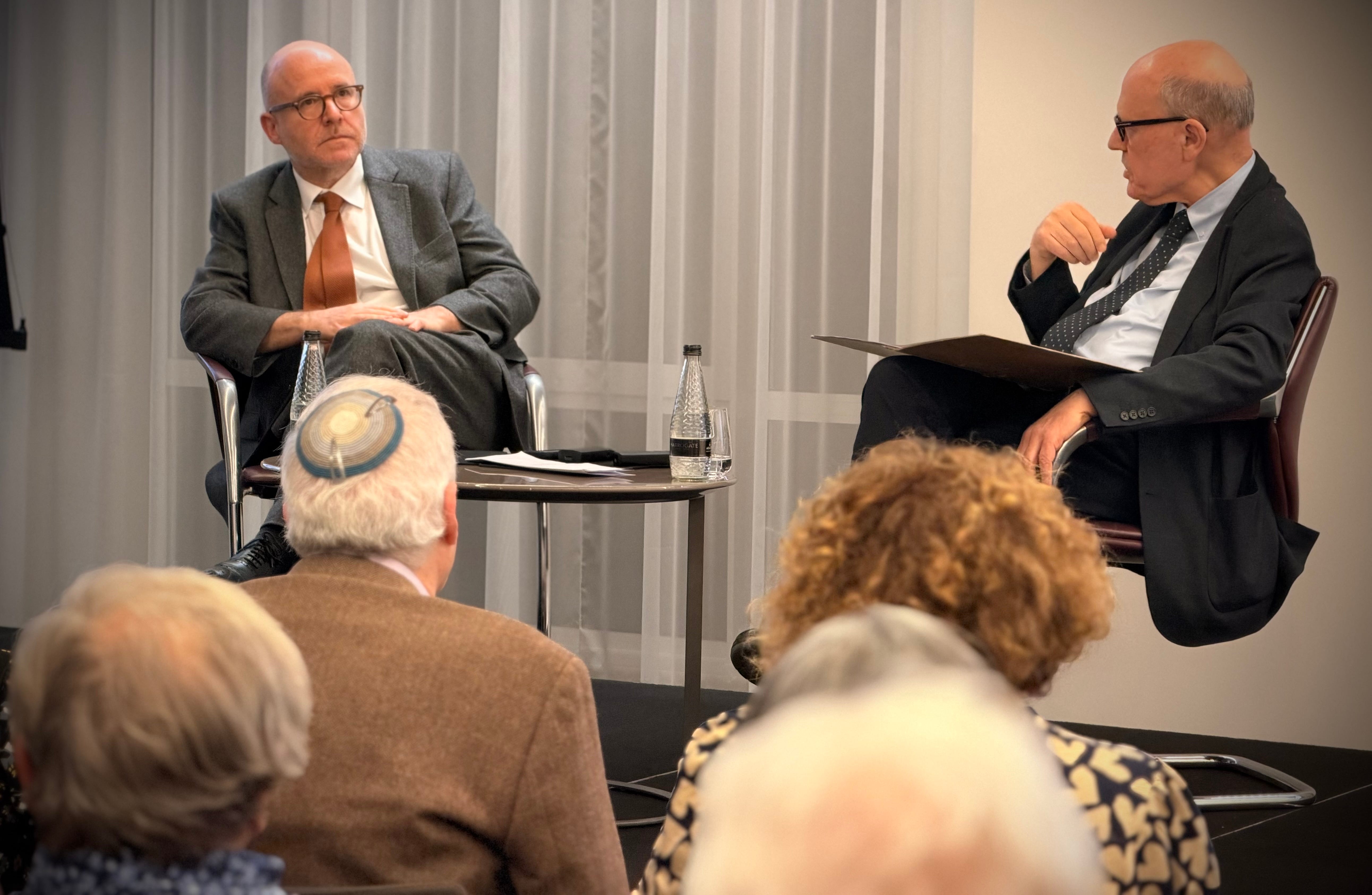
Hermer mentioned the trip when I interviewed him on Tuesday at a sold-out meeting arranged by the UK Association of Jewish Lawyers and Jurists. We were discussing the rise of antisemitism and the concern that many people in the Jewish community have that the government should be doing more to counter it.
Some Jewish people felt the government was not on their side, I suggested to its senior law officer, and they believed ministers were more worried about the Muslim vote than the Jewish vote.
“I think that is absolutely wrong,” Hermer replied. “What we are concerned about is ensuring a fair and tolerant society in which all groups, all minorities, feel safe to express their identities, to express their religious beliefs, without prioritising one over any other.”
He reminded me that Starmer had been determined to root out the evil of antisemitism in the Labour Party, expelling his predecessor Jeremy Corbyn. The prime minister was determined to fight antisemitism in all its manifestations, Hermer added.
Statehood
Later, I tried to find out whether the attorney general had advised ministers on whether Palestine met the generally agreed requirements for statehood, such as defined territory and effective government, ahead of the government’s decision last September to grant recognition. I suggested to him that there was a religious aspect to the government’s policy as well as a political one, since the Foreign Office minister Hamish Falconer had made a point of saying that his visit to the Palestine embassy in London last week was on the first day of Ramadan.
In line with the law officers’ convention, Hermer would not say whether or not he had advised on recognition. But it was a policy he said he had advocated for years. In his view it was the right decision to take, despite concerns among some sections of the Jewish community. “Did it land well with everybody? Obviously not,” he said. “I think we’ve got a duty to be out there explaining why we did it and I accept I’m never going to persuade everybody of my point of view.”
International law
We then moved on to broader areas of international law. Hermer thought the vast majority of countries recognised the benefits of a rules-based international order.
“Of course,” he continued, “it is under strain and tension at the moment, perhaps more so than it has ever been since 1945. That creates a really profound question for states, not least leading states like the UK: what do we do when others, including others that we would always previously expected to support the international rules-based order, take a different path?”
Such as the United States, I suggested.
He didn’t rise to the bait, while accepting that this was an unsettling time. “We could if we wanted to decide all bets are off, just be out for ourselves, not feel that we need to comply with international law, throw our weight around. I think that would be a grave mistake. I think the response at moments like this is to double down on what we believe in.”
Shouldn’t we support our allies?
In his view, there was no tension between doing that and complying with international law.
“But theoretically,” I suggested to the attorney general, “if the United States were to ask to use air bases in the United Kingdom to launch military action against Iran; and if, theoretically, you were to advise that a first strike on Iran would be against international law; then theoretically, there would be a conflict between the… desire of our strongest ally to protect the West and your commitment to the principles of international law, which say that you can’t strike first unless it really is a matter of anticipatory self-defence.”
“Nice try, Joshua,” was his reply. And he was not just saying that to comply with the law officers’ convention:
There are all sorts of reasons why I can’t respond to that and I want to be really careful because what I’m going to say is a non-answer to that — and I don’t want anybody think for one moment that I’m answering your question.
In this dangerous and complicated world, there are always challenges to our principles and beliefs. And the question is, well, do we make exceptions? Do we bend, or do we stay true to our principle?
To go back to the earlier questions you asked, not only my legal training, but my upbringing, my Judaism, my belief in tikkun olam, lead me to a conclusion that the answer is: you stick to your principles.
As it happens, within international humanitarian law there is an enormous degree of room for manoeuvre that time and time again has allowed us to work with allies in difficult situations. But ultimately, the lodestar that sees you through difficult times and difficult decisions is belief in the rule of law. And belief in the rule of law is not compatible with turning a blind eye or making unprincipled exceptions…
That is a general answer about a point of principle, rather than any scenario that you posited.1
Tikkun olam
Tikkun olam — translated as “repairing the world” — is a principle that Hermer has followed since he was a teenager. He regards it as a tripartite concept: not just repairing the world but also repairing the Jewish people and repairing oneself.
Some Jews see it as a cornerstone of their identity, I suggested to Hermer, while to others it’s little more than a vaguely Jewish way of embodying politically progressive orthodoxies.
Hermer places it within the wider framework of Jewish values — “a sense of importance of how you relate to your fellow human beings, the importance of the moral code, the importance of standards”.
I would not normally ask members of the government about their beliefs. But Hermer had mentioned the concept in public remarks a day after the terrorist attack on a synagogue in Manchester last Yom Kippur that led to the deaths of two members of the Jewish community.
I also suggested to him that when giving advice on customary international law he had a range of approaches to choose from and was bound to look for an approach that suited the government of which he was a member.
He disagreed. “My job as attorney is to apply the law objectively,” he said, “whether I’m looking at domestic law or whether I’m looking at international law.”
But surely lawyers try to give their clients the advice they want to hear, provided that advice is objectively accurate and consistent with legal authority? His reply was clear:
I think there is always a pressure… whether you’ve got a client wanting you to lean one way — or whether you’re attorney general, in which you’ve got political colleagues who would like a particular outcome — in which you have to decide what it is you believe in. I believe in the law and I believe in applying the law straight, because I believe that is absolutely essential to upholding the rule of law.
So there will be no doubt occasions in which I and attorneys general past and attorneys general future will have to deliver advice to people that they do not want to hear. But that is the job.
And tikkun olam was his answer when I suggested to him that the institutions of international law were deeply flawed. Didn’t we have to deal with the world as it was rather than as we would like it to be?
“The answer is to repair,” he said. “It is not to accept the world as it is but to try to make the world better.”
Better, better, better
Making things better was what Hermer was asked to do by many of those who asked questions from the floor.
Couldn’t there be further restrictions on hate speeches and aggressive marches?
His answer was that police and prosecutors were independent. Many of the audiences he spoke to argued that the government had gone too far in proscribing Palestine Action.
Couldn’t the UK government distance itself from those who misused the term “genocide”?
He accepted that it was a specific term in an international treaty which requires an “incredibly high threshold”. It didn’t just mean “war”.
If ministers really wanted to tackle antisemitism, shouldn’t they be countering the false narrative about Israel?
“False information generally, and the dissemination of false information, is something that we are very concerned about as a government.”
Why did the UK recognise a Palestinian state with no preconditions at a time when Hamas terrorists were still holding hostages?
Putting conditions on Hamas would have empowered a terrorist organisation, he replied.
Was the UK seeking to amend the human rights convention by supporting moves at a Council of Europe meeting in May?
“We are not seeking to amend any article in the convention,” he said. But the discussion that we were having within the Council of Europe was about how to keep core values and ensure that the convention stays up to the challenges of the time.
The challenges of office
One questioner wondered how he responded to the criticism he received in his early months as a lawyer-turned-politician. He had been accused of blocking other ministers’ policies.
“I think most of my colleagues, if not all my colleagues, recognise the importance of legal advice,” he replied. “If we get the law right at the beginning of a policy or a bit of legislation, we are less likely to find it held up in court for months and years to come.”
He had expected to be criticised for representing unpopular clients in the past because the prime minister had been attacked in the same way. For that reason, he told his office not to respond. On reflection, though, he felt he should have pushed back because it might have protected other advocates from attacks over the cases they did.
Footnote
It was a convivial hour and Hermer stayed behind to chat to the many lawyers who attended. By arrangement, there was no recording or live-stream but Hermer was very happy for his comments to be reported.
Update 28 February: Starmer said the UK “played no role” in military strikes by the US and Israel against Iran today. He added: “Our forces are active and British planes are in the sky today as part of coordinated regional defensive operations to protect our people, our interests, and our allies — as Britain has done before, in line with international law.”