
Badger Trust badgered
Judge issues bold type of warning after breach of trust

A High Court judge delivered a shouty message yesterday about respecting restrictions on the draft judgments that are provided in confidence to parties and their lawyers. Mr Justice Fordham was ruling on what he described as “another case about the vital distinction between a court embargo and a journalism embargo”.

After explaining that a court embargo had been breached in a case about badgers, he continued:
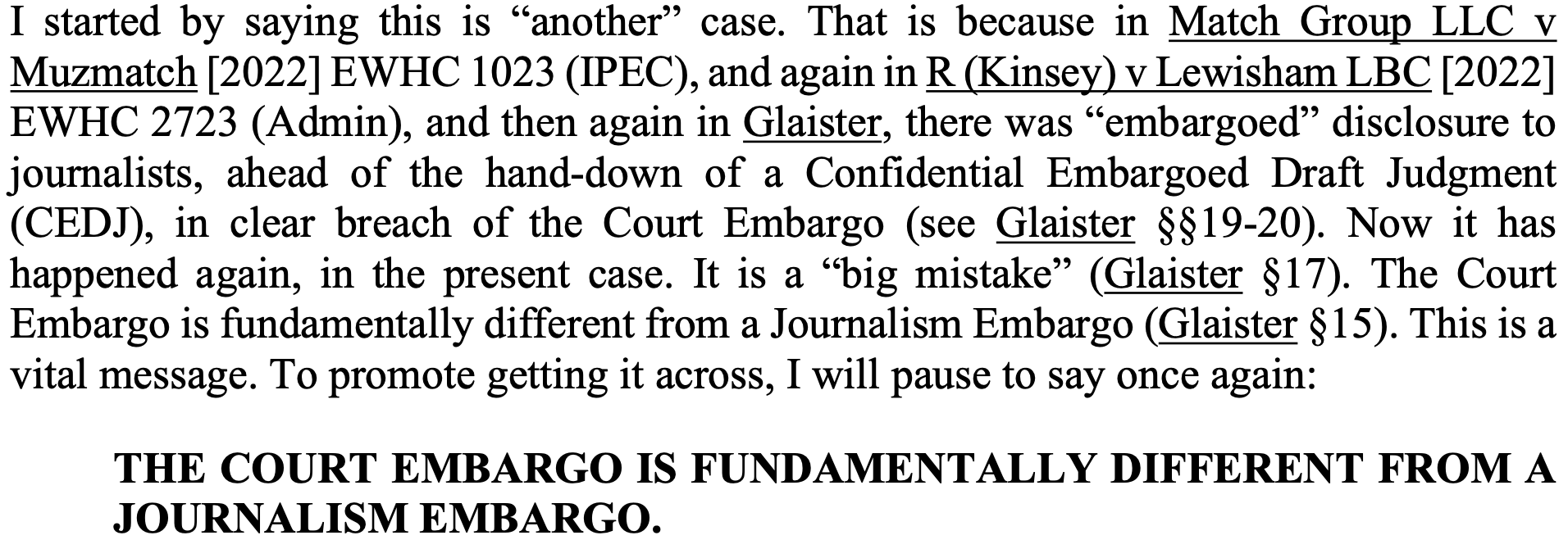
The breach occurred in a case brought by the conservation group Badger Trust and a litigation support campaign group called Wild Justice against a decision taken in 2024 by the public body Natural England to issue a number of badger cull licences. After hearing oral argument last month, Fordham drafted a written judgment concluding that Natural England had not acted unlawfully. He refused to make advisory declarations sought by the claimants.
The judge scheduled his judgment for delivery at 10am on 26 June. Judgments such as this are normally “handed down” remotely: finalised copies are sent to the parties through their lawyers and published online.
It is common practice for judges to send drafts to the lawyers some days earlier so that rulings can be checked for errors and parties can be advised on their next steps. That was done on 18 June, two days after the hearing and just over a week before hand-down.
Within a hour, the claimants’ solicitors, Leigh Day, had emailed the draft to Badger Trust and Wild Justice. A covering email told them:
Please note that this draft is confidential to the parties and their legal representatives. Neither the draft itself nor its substance may be disclosed to any other person or used in the public domain. The parties must take all reasonable steps to ensure that its confidentiality is preserved.
No action is to be taken (other than internally) in response to the draft before judgment has been formally pronounced in open court. A breach of any of these obligations may be treated as contempt of court.
Despite this, Wild Justice circulated a draft press release on 25 June. It was marked “embargoed until 10am on 26 June 2026”. A solicitor at Leigh Day who saw it told Wild Justice it was important that the press release was “not sent to journalists, even under embargo, until we have confirmation that judgment has been handed down. That may be after 10am.”
After Fordham’s judgment had been handed down the following morning at 1005, the same solicitor discovered that Badger Trust had sent the press release to 85 members of the press (but not me) just over half an hour before the planned hand-down time.
The solicitor took immediate action to report the embargo breach to his clients and the court, as he was required to do. Leigh Day “have acted with complete propriety”, the judge observed.
What went wrong?
The chief executive of Badger Trust, who sent out the press release, had not seen either the confidential draft judgment, the covering note from Leigh Day on 18 June or the solicitors’ email to Wild Justice a week later. All he had to go on was the press release drafted by Wild Justice.
He marked it with a press embargo of 12 noon, a comfortable two hours after the expected hand-down, but sent it out at 0926, unaware that this was in breach of the court embargo. The chair of Badger Trust, who had been in touch with the solicitors, had no idea that her chief executive would take that step — though she recognised that she should have been clearer with him.
Badger Trust apologised to the court and agreed to reimburse the environment secretary’s costs of £900 for preparing written submissions on the issue.
“I can see the combination of features which created the problem,” said Fordham. “It was human error. I will not castigate it through the prism of hindsight.”
Comment
The case was closed. But Fordham ended his judgment with a warning:
No party with whom a confidential embargoed draft judgment has been shared by the court is permitted to alert — or communicate their position on — the outcome or content of an upcoming judgment to the press or anyone else.
No communication of that nature is permissible ahead of receipt of finalised handed-down judgment. It is a breach of a duty imposed by the court and owed to the court.
It is significant. It can also be a contempt of court. The court will always investigate it fully and treat it very seriously.
We can expect Badger Trust to dig more deeply next time.
This routinely seems to occur with Fordham J’s judgments. I appeared in Kinsey. But it also occurred in another one he has not mentioned. My own view is that this is because he leaves judgments in draft for too long. In this day and age this inevitably greatly increases the risk of such breaches occuring - no matter how diligent the main parties are. Draft judgments should be kept as such for a very short period - not for 10-14 days.