
Bringing down the backlog
Sheriff says we would be losing a valuable asset for minimal gain

A City of London alderman whose duties include supporting the Old Bailey judges has added his voice to the growing criticism of the government’s proposed jury reforms.
Robert Hughes-Penney, an investment director, is one of two sheriffs who are based at the Central Criminal Court during the week to assist with the City judges’ social and charitable responsibilities.

In remarks prepared for delivery at a forthcoming Old Bailey event, Hughes-Penney writes:
Given that magistrates’ courts handle over 90% of criminal cases and jury trials account for only about 1%, reducing jury trials for efficiency is akin to selling a valuable asset for minimal gain. With a more creative approach, we can achieve greater improvements without undermining centuries-old traditions.
He adds:
The criminal justice system faces big challenges, but cutting jury trials isn’t a simple fix. Sustainable efficiency will require a series of targeted improvements across multiple areas. Keeping the system fair and robust should be the priority.
Although they do not speak for the Old Bailey judges, the two City sheriffs see them at lunchtime and are unlikely to express views with which the judges would disagree.
Hughes-Penney is hosting a series of five evening events at the Old Bailey during his year of office, with the theme of Justice for All. The next, on 4 February, is subtitled Justice for the Accused.
The debate around jury trials will be part of the conversation, he says, but speakers will also explore a range of incremental changes that, together, could deliver more meaningful progress.
These might include:
Extending the court day by 30 minutes, which could increase output by 10%.
Introducing shift work for judges.
Reopening closed court buildings.
Bringing back retired judges to work part-time as judges in some courts.
Handling some hearings, like bail requests, in writing instead of in person.
Leveraging AI tools to streamline research and administrative tasks.
He concludes:
If the goal is to improve the system as a whole, focusing solely on reducing jury trials is unlikely to deliver the desired results and may have unintended consequences. For example, juries tend to be more cautious than judges, so moving to judge-only trials might mean more convictions, adding further strain to already overcrowded prisons.
Comment
James Rossiter, director of communications for the Criminal Bar Association, reported this week that four of 18 courtrooms at the Old Bailey were not in use. He blamed the present government for cutting judges’ sitting days on taking office and reducing the number of part-time judges who could hear cases.
The reforms outlined by Hughes-Penney would clearly need funding. But, speaking as an investment director, he argues that they would also save money: ineffective trials waste valuable court resources while reoffending remains a major cost to society.
Pressure is growing on the government to put aside its long-term plans for jury reform and concentrate on short-term improvements that will help tackle an unsustainable backlog of cases awaiting trial.
Institute for Government
Since drafting these comments I have seen a new analysis by the Institute for Government. This is a summary of the think tank’s conclusions:
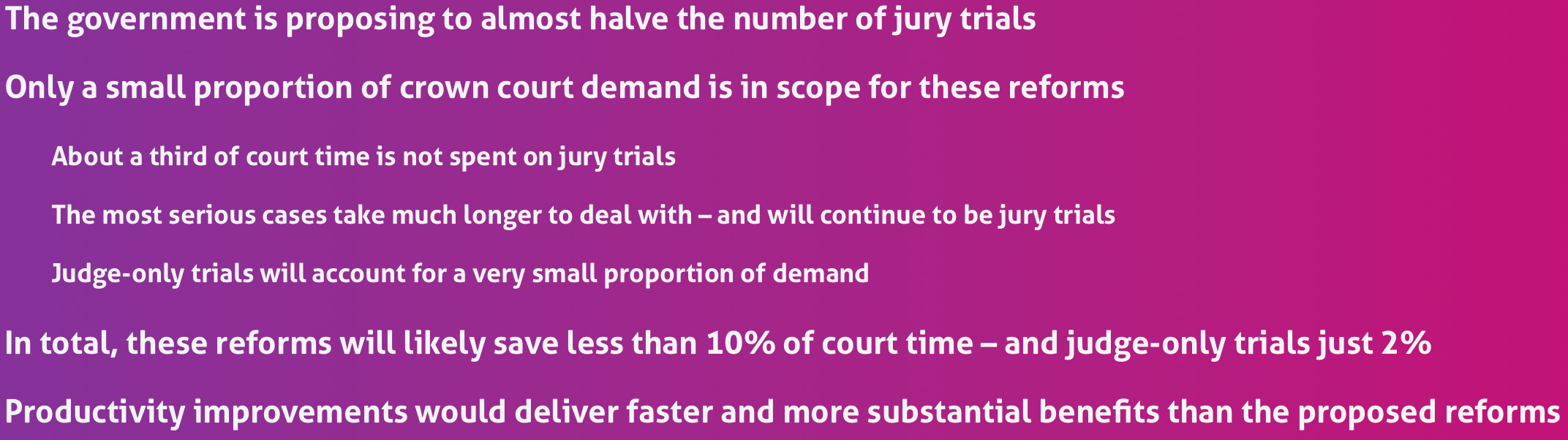
Its analysis says:
The government is likely to have a fight on its hands to get legislation through the House of Lords, even if it passes the Commons. The ground seems especially shaky for judge-only trials, given these will provide only marginal savings and the move most risks damaging public confidence in the criminal justice system.
There is an alternative which enjoys broad support across the sector and could begin much faster: improving court productivity. Productivity is at the heart of the problem in the criminal courts. The crown court is hearing almost 20% fewer hours per sitting day so far in 2025/26 than it was in 2016/17. If it had got through an equivalent number of cases per day in 2024 as in 2016, the case backlog would have fallen by at least a few thousand. Instead, it grew by nearly 8,000 (10%).
Our recent Public Services Performance Tracker 2025 explored some of the reasons behind the widening productivity gap that has opened up in the crown court in recent years. These include a shortage of criminal lawyers, poor court administration and a long-running lack of investment in court buildings and physical and technological infrastructure. These are not quick or easy problems to fix, but even so there are opportunities for meaningful improvements before 2029. These could be done alongside more moderate proposals to handle some more cases in magistrates’ courts, which would be less likely to provoke backlash.
Initial steps like matched funding for criminal pupillages (barrister trainee positions) and increasing criminal legal aid fees are welcome and should help to restore criminal lawyer numbers. Similarly, increased maintenance funding should reduce time lost to broken fire alarms and flooded court rooms.
But more can be done. The government should focus on understanding what is driving differences in court productivity around the country, with crown courts in Liverpool and much of Wales consistently cited as high performers. Are there particular approaches to how cases are listed for trial or judicial behaviour that could be applied elsewhere? What explains the wide variation in the proportion of trials rescheduled at the last minute?
Phase two of the Independent Review of the Criminal Courts is focused on court efficiency and should address many of these key questions. Publication is now expected in spring 2026. Sir Brian Leveson has previously stated that he does not think a “modest change” from efficiency improvements will be enough to get to grips with the situation and bring the case backlog down.
But the potential benefits of returning crown court productivity to 2016 levels substantially outweigh the likely demand savings from the structural reforms the government is proposing. That is where the government should start.
It seems to me that this approach offers the government an elegant way out of the problem it has created for itself. Ministers should announce that they are deferring a decision on whether to introduce legislation until the next King’s Speech, expected on 12 or 13 May.
The proposed reforms are said to be long-term in nature and would be introduced regardless of the current crisis. Given that they would not have any impact on the backlog for two or three years, deferring an announcement for a few months is not going to worsen the delays.
In the meantime, as everyone now says, ministers must put all their resources into improving court efficiency.
I entirely agree with the suggestion that we should increase Judges sitting days, courts are currently restricted as to the use of Recorders, I practice in Bristol our courts are often under utilised because of these restrictions.
A further issue that needs to be addressed is ensuring prisoners are produced to court in a timely fashion which. Is often not the case, this has the effect of adding days if not weeks to the length of a trial.
Ian kelcey
What a relief to read common sense proposals for dealing with the back log problem effectively without the serious effect of denying jury trials. Thank you!