
Crisis or opportunity?
Government to publish jury reform legislation today

The justice secretary David Lammy is expected to publish his court reform bill this afternoon. We’re told it will be very much in line with what ministers have set out in recent months. “We have stuck with the plan,” a government source said yesterday.
What’s slightly more of a surprise is the timing. Ministers hope their bill will complete its parliamentary passage by the end of this year. It will then take the Ministry of Justice the whole of next year to prepare for the legislation to be implemented: IT platforms will have to be updated, court rules must be amended and there will need to be staff training.
That means judge-alone trials for some cases currently decided by juries will not be introduced until 2028.
In the meantime, the waiting list for crown court trials will rise from its present level of 80,000 to an estimated 100,000. “Things get worse before they get better,” the source admitted. “But they do get better, under this plan, before the end of this parliament.”
That’s clear from government projections released yesterday:
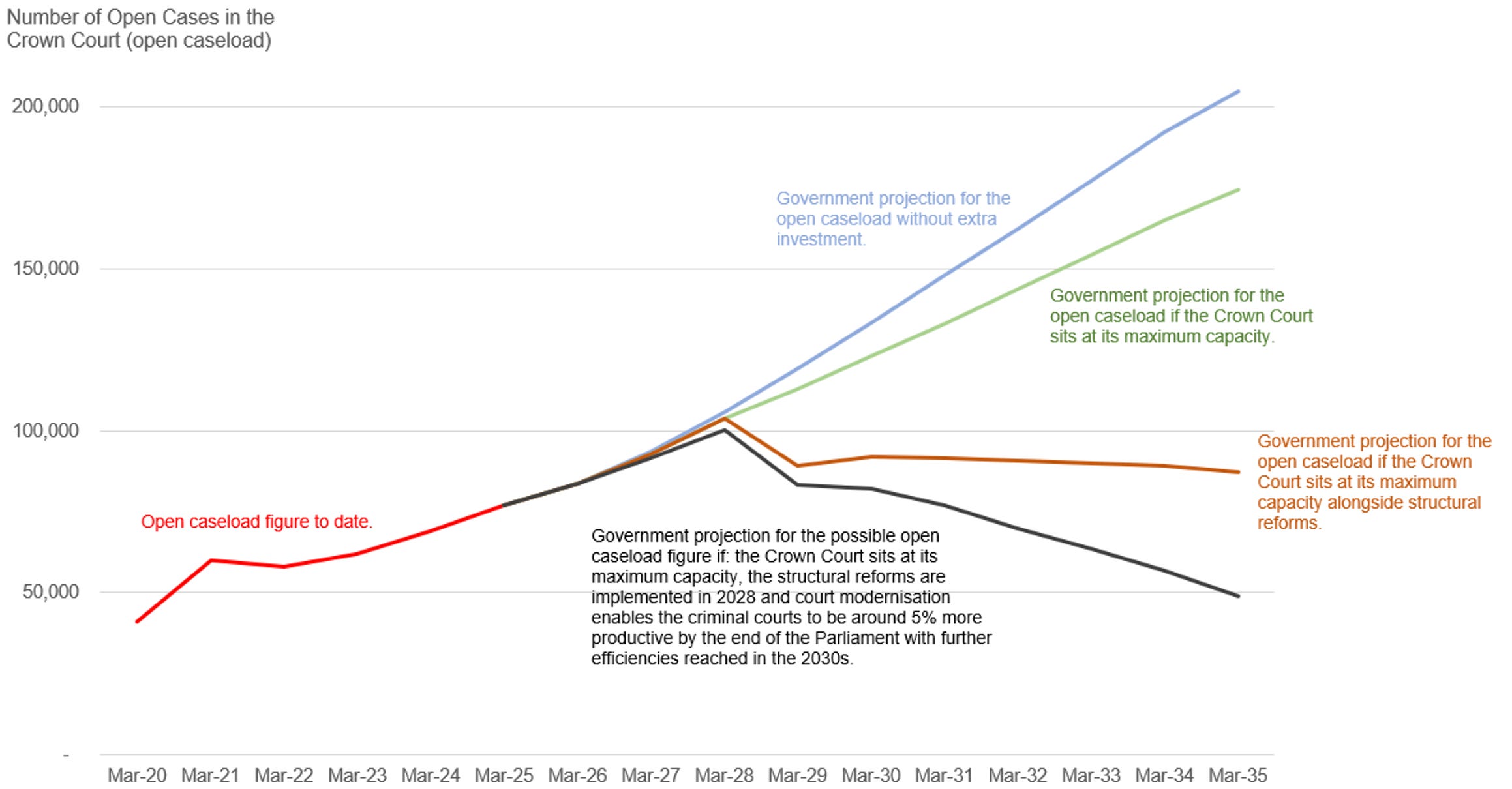
The graph is not very easy to read but what it indicates is that the backlog will fall below 50,000 by March 2035 — but only if the crown court sits at maximum capacity, structural reforms are implemented in 2028 and modernisation enables the courts to become more productive.
In the government’s view, investment, modernisation and reform are all needed. If nothing is done, the backlog will rise above 200,000 over the next nine years. Before the Covid pandemic, it was just under 40,000.
Lammy announced some of his proposals yesterday in a speech at the Microsoft AI Tour, an event in Docklands. You can watch a substantial extract here:
Asked why the government would not be making the changes temporary, as his colleague Karl Turner MP had suggested, Lammy replied:
Of course I’ve listened and reflected and consulted with members of parliament, including in my own party, as you would expect.
I was with a group of MPs just yesterday, absolutely supportive and determined to see us push through and press ahead with these reforms…
Many colleagues have said, look David, you’ve got to find more money for the courts. Today I’ve announced that we’ve found more money for the courts.
Many of them have said, there are huge inefficiencies. You’ve got to get prisoners to court on time. You’ve got to fix the court maintenance backlog. Today I’ve announced fixing that backlog and getting those prisoners to court on time.
Some of them have suggested that if we did those two things, we wouldn’t need court reform. And I’m really clear that when they look at the data, when they look at the evidence as Sir Brian [Leveson] did in detail, they will accept and understand that we have to do all three of these changes. And it is right that government makes this threshold change particularly so that [for sentences] up to three years we see those cases move more swiftly through the system…
The Bar Council has been particularly focused on this jury change. And we will continue to discuss this with them. I would just say this, having qualified as a barrister back in 1995: it can sometimes be a conservative profession, with a small C.
The bar opposed changes to the double jeopardy rule. Those changes to the double jeopardy rule are what delivered partial justice for the Lawrence family. The Bar Council opposed giving solicitors greater advocacy rights. I think that’s been an important change and I actually want to see more solicitors able to become judges in our system because there’s real diversity amongst our solicitors across the country.
So we’ll continue to have the debate but I would say now: look at all of this in its entirety, look at what we’re proposing and you’ll understand why we’re making the changes..
Answers
In briefing with reporters earlier, the government source answered one of the most pertinent questions raised by the Commons justice committee in correspondence that I reported last week. MPs wanted to know whether a defendant who had elected to be tried in the crown court on the understanding that this would involve a jury trial might be tried by a judge sitting alone in the new bench division if the legislation had taken effect in the meantime.
The answer is “yes”. There is no right to a jury trial, the source said; only a right to a fair trial. The government had taken legal advice from leading counsel on the legality of applying new procedural rules to cases already within the system. There was no impediment, ministers had been told.
The source would not say which barrister had been asked to advise but I would be amazed if it was not David Perry KC.
Here, in no particular order, are some other plans we heard of yesterday.
Blitz courts: nothing to do with wartime bombing raids, these are courts that hear and dispose of a large number of straightforward cases during a short period of time. They have been used successfully by enterprising crown court judges in places such as Liverpool. Starting shortly in London, they will deal with assaults on emergency workers — an offence that is notoriously wasteful of crown court time.
National listing model: although listing remains a judicial function, the lady chief justice will be publishing a listing framework that will ensure cases are given the same priority wherever they are tried in England and Wales. An AI listing tool is being piloted at crown courts in Preston and Isleworth. It’s called J-AI.
No cap: for the next three years, there will no longer be a government-imposed limit on the number of days that the crown court can sit.
More broadcasting: at present, only senior judges can be seen on television when sentencing offenders. There are discussions with the lady chief justice on extending the pool of eligible judges.
More video: more hearings in the magistrates’ courts and the crown court will be conducted remotely, saving travel time.
Prison buses: not only will prison vans be allowed to use bus lanes if local authorities agree, they may even be given the technology to turn the next set of traffic lights green — a facility that some emergency vehicles have at the moment.
“This is, in large part, about turning a crisis into an opportunity,” the source told reporters. Not long to wait before we can judge how well it’s likely to work.
Update 1700: the bill was published earlier this afternoon, together with accompanying documents.
The government projections don’t disaggregate the contributions made by more money and their “structural reforms”. And supposing the reforms get through unscathed, it will be impossible to disaggregate the contributions of those to any real-world reduction, too.
For me that makes this a policy with no rational basis. The hunch that axing jury trials will cut the backlog is plausible, but I don’t see it can be more than a hunch.
I hope Joshua and other commentators can dig into the modelling, especially since this graph is the first time we’ve seen any at all - only after the policy has been decided.
Dear Lord Chancellor
Without radical legislative reforms, you could cut waiting lists for Crown Court trials immediately, by -
* Mandatory plea and case management hearings (on remote platform) in every case;
Submissions in the absence of the jury after court hours (4.30 pm onwards)
Start hearings at 9.30 and end at 4.30 every sitting day
Increase number of Recorders