
Daily Mail vindicated
Prince Harry accuses High Court judge of whitewash

It is one thing to claim your private information has been obtained by an investigator “blagging” information unlawfully or hacking into your phone calls. But it is quite another thing to prove, on the balance of probabilities, that a particular news story was the result of unlawful information-gathering by the newspaper that published it.
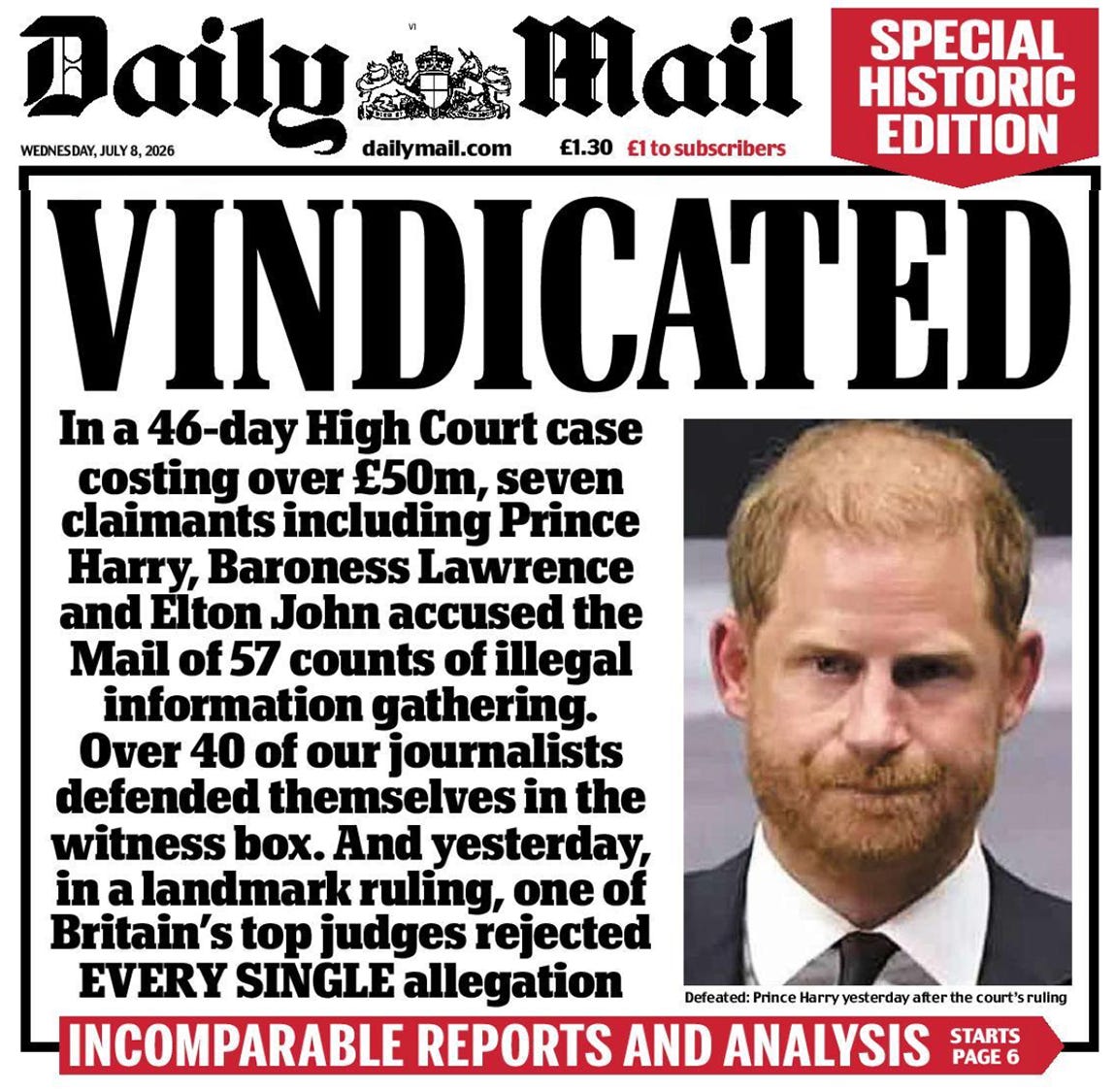
Mr Justice Nicklin examined more than 50 reports published by Associated Newspapers between 1997 and 2015 in the 436-page judgment he delivered yesterday. In none of them did he find that the Duke of Sussex or any of six other celebrity claimants had proved their claims.
That’s not to say that corners were never cut. The publishers accepted that “third-party investigators” were used and that some wrongdoing existed in the newspaper industry. But they said this did not establish that unlawful information-gathering occurred in any particular instance, still less that it could be linked to specific stories that they had published.
“Associated accepts (as part of the wider factual background) its use of third-party investigators,” Nicklin said. That use had been disclosed to the Leveson inquiry, which reported in 2012.
“The evidential picture that emerged at the trial supports and reinforces that conclusion,” he continued. “In the period up to 2007, third-party investigators instructed by Associated regularly provided information to its journalists in circumstances which raise at least a prima facie case that the information had been obtained unlawfully.”
Why were they needed?
“Third-party investigators were used as a time-saving mechanism in circumstances where internal searching was said to be slower or impractical,” the publishers argued. In the days before reporters working off-base had laptops with internet connections, it was easier for them to ask investigators to find numbers for people they were inviting to comment.
Harry and the other claimants argued that the scale of their use was more readily explained by the ability of investigators to obtain information that could not be lawfully obtained through a newspaper’s own resources. But, time and again, Nicklin found that Harry had failed to prove that specific information had been obtained by unlawful means.
Sometimes, his lawyers tried to move the goalposts. In December 2002, the Mail on Sunday had published an article under the headline “Harry’s older woman”. He alleged that the reporter, Katie Nicholl, had obtained the phone number of a woman named Natalie Pinkham and then commissioned a blagger to obtain itemised billing data, from which it was inferred that Prince Harry had been in regular contact with her.
Under cross-examination, Nicholl was accused of intercepting voicemails herself. If that was the allegation, said the judge, the reporter should have been given proper notice of it. “It is not permissible to confront a witness for the first time in the witness box with a materially different and more serious mechanism of unlawful information-gathering than that which has been pleaded,” Nicklin said. In any event, he accepted Nicholl’s evidence that her article had been lawfully sourced.
In a joint statement after the ruling, Harry and Baroness Lawrence of Clarendon, whose son Stephen was murdered in 1993, said: “We came to court seeking justice and accountability. But we have received neither. It is a complete and obvious whitewash, but sadly not altogether unexpected.”
Harry and other claimants may now feel that the odds were stacked against them. How could they possibly prove wrongdoing in individual cases unless a court was prepared to conclude that, in all the circumstances, it was more likely than not?
The judge accepted that, given the nature and age of the allegations, the claimants’ cases often depended on inference. But suspicion, even where understandable, was not enough. The claimants had to prove that the information complained of had been obtained unlawfully.
Nicklin rejected the argument that, simply because information was private —and because the publishers could not explain where it had come from — an article based on that information must have been unlawfully sourced.
Turning to the claimants’ allegations that three senior executives from Associated Newspapers had knowingly given false evidence to Sir Brian Leveson, Nicklin found these had not been proved. That did not mean the publishers’ response to the inquiry was beyond criticism. But the judge was “not conducting a public inquiry into the adequacy of Associated’s response to, or engagement with, the Leveson inquiry”.
Describing the ruling as “a magnificent vindication of the Daily Mail’s journalism”, Associated Newspapers said it had “wasted so much valuable court time and more than £50m in legal costs”. What remains to be seen is how much of those costs will fall to be paid by Harry and his fellow claimants.
The normal rule is that the losing side in litigation must reimburse the winner and well as paying its own lawyers. Unless agreement can be reached — which seems unlikely — this and any other outstanding issues will be considered by the judge during a two-day hearing at the end of this month.
Phone-hacking claims against other newspapers have been successful in the past. Harry won substantial damages from the Daily Mirror and settled his case against the Sun. Offered settlements by publishers, other claimants said they could not afford the risk of going to court and losing. We now see what a huge risk it was.