
Judicial pragmatism
We hear what you say but don’t tell us what to do, judges tell states

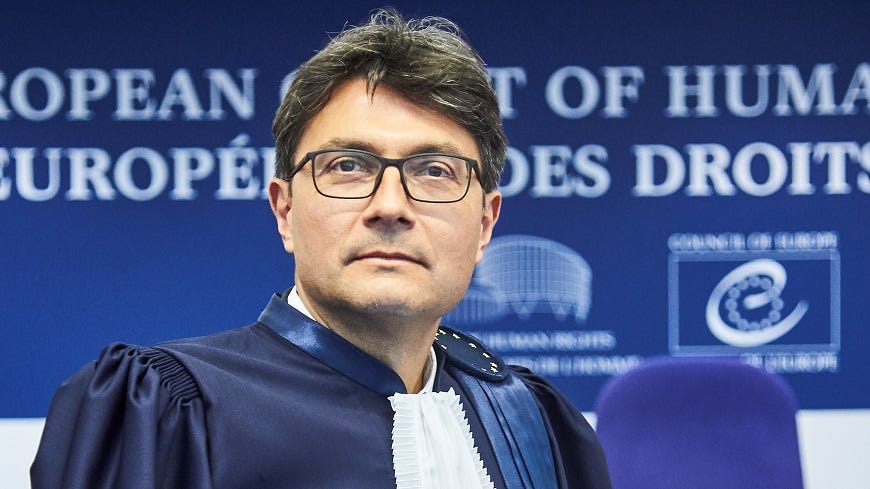
The president of the European Court of Human Rights spoke yesterday of “judicial pragmatism” when asked about concerns raised by states that have signed the human rights convention.
Mattias Guyomar said that he and the other judges would apply the convention “within a given context”. But respect for the court’s “full independence” was essential to its credibility, he insisted.
Background
The human rights court is supervised by the Council of Europe. At a meeting of justice ministers in Strasbourg last month, 27 of the council’s 46 member states, including the United Kingdom, called for a rebalancing of the human rights convention.
In finding the “right balance” between the rights of individual migrants and the public interest in security, the 27 states said it was vital for article 8 of the convention, which protects family life, to be “adjusted” so that more weight was put on the nature and seriousness of an offence committed by a foreigner “and less weight is put on the foreign criminal’s social, cultural and family ties with the host country” — where the foreigner was now living — as well as with the “country of destination”. Their aim is to ensure that states can expel foreigners convicted of serious crimes even if they have established a family life in their host country.
The justice ministers agreed that a political declaration should be drafted for signature at a ministerial meeting in Moldova on 15 May. This will not amend the human rights convention, a process that usually takes years. But the big question is what effect a political declaration by the member states will have on the court. Will the judges recognise the concerns of the 27 states — and others that may join them in the coming months — when interpreting article 8 and other provisions? And would that be enough to satisfy politicians who seek to withdraw from the convention?
Guyomar, the French judge, became president of the court eight months ago. He spoke to reporters in Strasbourg yesterday morning. I couldn’t attend so I sent in a written question. Guyomar is well aware of the context I have just summarised.
Question
The was my question:
When deciding cases, to what extent is it appropriate for the court to take account of concerns expressed in political declarations made by the high contracting parties?
Answer
This was the president’s answer:
There have been many political declarations within the framework of the Council of Europe and in particular since the 2010 high-level diplomatic conference in Interlaken. The court has been receptive to the messages conveyed in these institutional declarations, which have also as a general rule been helpful to the convention system.
Indeed, the court does not adjudicate in a vacuum. Judicial pragmatism means that the court applies the text (the convention) within a given context. However, the integrity of its judicial role relies on the full respect of the separation of powers and the absence of any kind of political pressure.
Respect for the full independence of the European Court of Human Rights is essential to Europe’s shared values — human rights, democracy, and the rule of law — and to its continuing credibility.
Comment
This strikes me as a carefully balanced response. Past political declarations have been helpful, he begins, “as a general rule”.
Then, Guyomar tells the member states that the judges are listening to them. The court does not operate in a vacuum and it interprets the human rights convention in “context” — a term that presumably includes the political realities.
However, he adds immediately, it is not for the member states to put political pressure on the judges. Doing so would undermine the court’s credibility.
In a sentence, then — we hear what you say but don’t tell us what to do.
Annual report
Launching the court’s annual report yesterday, Guyomar told journalists that its backlog had been reduced by 11% during the course of 2025. At 53,450 cases, it’s the lowest figure for 20 years.
Only around 1.5% of those pending cases concern migration either directly or indirectly, he stressed.
The number of pending applications against the UK is 139, or 0.3% of the total.

The court delivered a total of 914 judgments in 2025. In 816, it found at least one violation of the human rights convention.
Ten of the 914 judgments involved claims against the UK. In six of them, the court found no violation.
Last year, 261 UK applications reached the stage of being considered by a judge. This represents four applications for every one million inhabitants, the lowest rate of all Council of Europe member states.
Those stats are very interesting. To listen to some of the loudest voices in U.K. politics one might think that the ECtHR adjudicates against the U.K. in an immigration case every week if not every day and that it always loses.
The truth is rather different.
In a sentence, then — we hear what you say but don’t tell us what to do.
An English judge would say the same. Full marks