
Preventing early releases
What options does the government now have?

While PC Andrew Harper’s killers wait to hear what proportion of their prison sentences they’ll spend in custody, his mother asked Andy Burnham yesterday not to “let us down again”. So it’s worth taking a closer look at the prime minister’s options — starting with the announcement he published on Tuesday morning.
You might have expected to read it here:

Or perhaps here:
In fact, it’s to be found here:
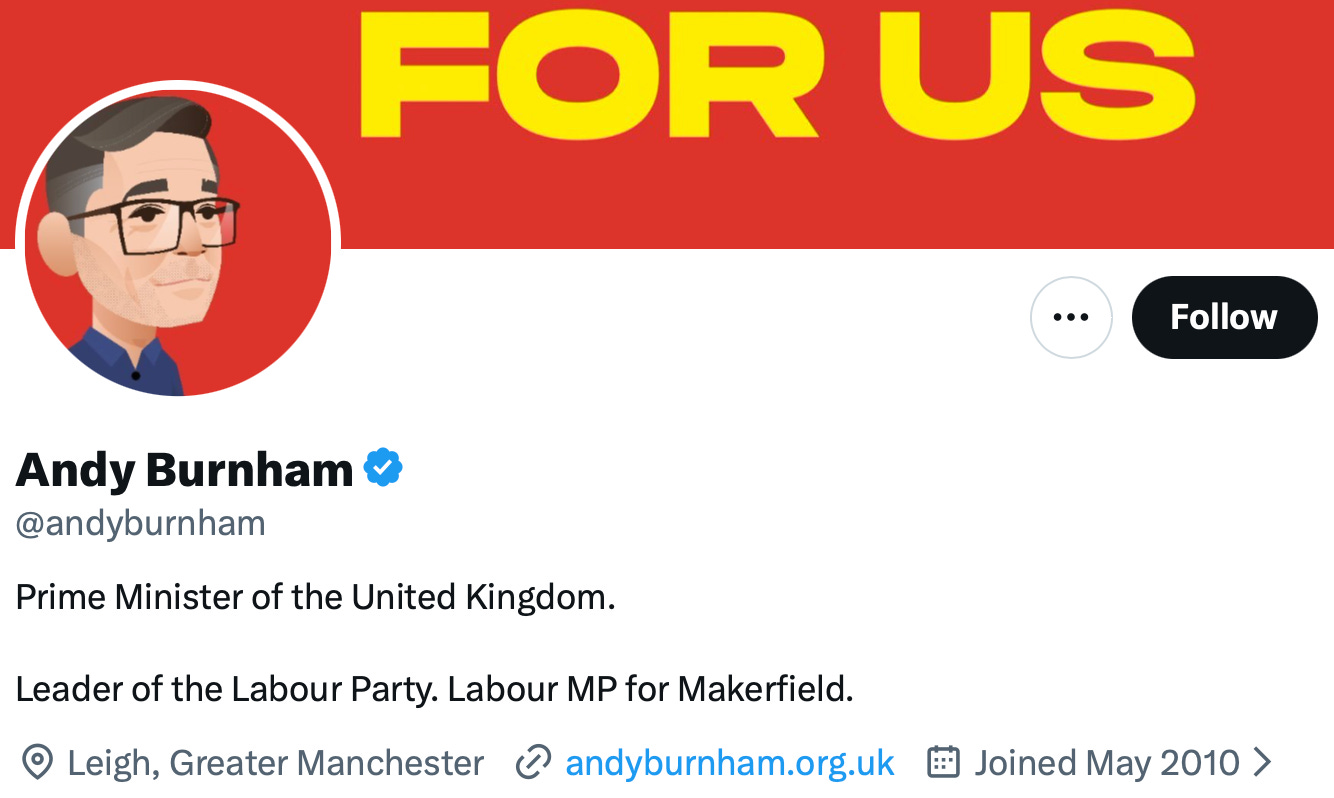
Preventing early release altogether?
The prime minister announced on social media that he had asked his justice secretary, Alex Norris, to create more headroom within the prison system. A fast-track plan would be presented to parliament next month, he promised.
MPs return on 1 September and then sit for two weeks before breaking again for the party conference season.
After outlining three options, Burnham said this on Tuesday:
I am increasingly confident that a more focused approach along these lines will allow us to reduce the number of people released early and, in the case of the most serious offenders like those convicted of the killing of PC Harper, prevent their early release altogether.
Three men were convicted of Harper’s manslaughter. Henry Long, the ringleader and driver, was sentenced to 16 years, to be followed by a further three years on licence. Albert Bowers and Jessie Cole, who are younger than Long, were given 13 years.
Long received what’s called an extended determinate sentence. That means he will be considered for release after serving two-thirds of that period. He is entitled to release after 16 years. As I understand it, his sentence is not affected by the Sentencing Act 2026.
Bowers and Cole were told by the trial judge that they would serve two-thirds of their 13-year sentences in custody and the remainder on licence. As a result of the Sentencing Act 2026, they were expecting to be released at the halfway point of their sentences.
But Burnham says he hopes to “prevent their early release altogether”. Does that mean they will serve the full 13-year sentences passed by the court? That’s what I thought the prime minister was saying. But as there has been no briefing from Downing Street to this effect it’s safer to assume this was simply a loosely worded social media post.
Ministerial powers
As I explained a week ago, provisions in the Sentencing Act come into force when ministers make commencement orders. “Different days may be appointed for different purposes or areas,” the statute says.
That means different crimes can be treated differently: if ministers wish to exclude particular offences from the early release provisions, they can do so. But the statute does not allow some offenders who receive a punishment for a crime to be treated differently from other offenders who received the same punishment for the same crime: it does not say “different days may be appointed for different people”.
I think “different purposes” could cover offenders serving more than a specified period for a specified offence; for example, someone sentenced to more than 10 years for manslaughter could be excluded.
The Times reports that Burnham was presented with two options but did not pursue them. Under the proposals, all prisoners sentenced to either more than 10 years or more than seven years would not have been eligible for early release.
The Conservatives are calling on the government to pass emergency legislation next month. But I cannot see what that would achieve. Burnham could exempt manslaughter from the existing early-release provisions without the need for primary legislation. The problem is that this would increase pressure on prison places.
According to the Telegraph, there are thought to be around 470 people convicted of manslaughter in jail. Officials are said to believe that making them serve more of their sentences in custody would overwhelm the prisons.
I don’t see how manslaughter of an emergency worker could be treated differently from manslaughter of anyone else under the early-release provisions unless the offender had been sentenced to life imprisonment under legislation that came into force in 2022 — in which case the Sentencing Act 2026 would not apply.
The prison service could certainly not be expected to go through offenders’ case files and decide whether the victim qualified as an emergency worker under legislation that was not in force at the time. And legislation could not increase the sentences of those already sentenced without breaching fundamental principles — as well as article 7 of the human rights convention.
IPP prisoners
Burnham suggested three ways of reducing the prison population:
increasing the rate of removal of foreign national offenders to their country of origin;
finding an early resolution to the long-running injustice of IPP sentences; and
using the female estate for male offenders.
Of these, the most promising is releasing offenders serving indefinite sentences for public protection — IPP prisoners. As is well known, some of these offenders have spent extraordinarily long periods in prison for relatively minor offences. The Criminal Cases Review Commission is continuing to review cases that may lead to successful appeals but there are still more than 2,000 IPP prisoners behind bars.
Last month, a report issued by the UN Human Rights Council’s working group on arbitrary detention called on the government to “remedy the situation” of four named IPP prisoners. One of them was Leroy Douglas, 45, who was convicted in 2007 of a mobile phone robbery and breach of licence conditions. As a result, he appears to have spent more than 20 years in prison.
Although the Conservative justice secretary Alex Chalk made it less likely that IPP prisoners would be at risk of recall by reducing the period during which they would remain on licence, no justice secretary has been willing to resolve this scandal. What has always worried ministers is that released IPP prisoners would pose a danger to the public.
But the same can be said of prisoners who have served fixed sentences. The difference is that some IPP prisoners are now considered dangerous because of the effect that an open-ended sentence has had on their mental health.
Comment
The government should take urgent steps to review all remaining IPP prisoners with a view to releasing them unconditionally — rather than on licence, as at present. Some of them may well commit further offences. But that is a reputational risk ministers will simply have to accept.
Whether that can be done quickly enough to achieve the prime minister’s objectives is quite another matter.
Much wise comment has resulted from Joshua’s characteristically shrewd analysis.
I have long been anguishing over the shamefully becalmed IPP legacy.
Blaming previous Conservative governments might prove to be a two-edged sword since Blair,Brown and Starmer administrations exhibited no serious enthusiasm actually to do much about it. If-repeat, if- I should have wished to support the Badenoch opposition then I would encourage it to fire a salvo or several across the government’s bows to that effect, where that might quieten down this blame game.
The dilemma for this or any other executive is that what is needed to make any serious inroads is a two - pronged spasm of honesty AND courage. With that approach would have to come the initiation of suchlike as house arrest for the non violent as Ros Wright says AND a huge
, immediate investment in the Probation Service/ with a guarantee of continuity thereof. That would after all be far cheaper than prison building and more effective.
Also, see the
Observer’s Rachel Sylvester in last Sunday’s edition about “Scandi wings”.There needs to be less of the timidity and far more of the facing up to the reality, with no more “bidding wars” (as per Sir David Gauke) where the PCHarper affair is shaping up to be a species of just that.
Well done for highlighting the IPP scandal again, Joshua. As you've implied, there is a lot more scope for freeing up prison places by sorting out the grim farce of IPP than by tinkering with the rules around early release for those convicted of manslaughter.