
Regulator loses its way
Legal Services Board acknowledges ‘significant consumer detriment’

The oversight regulator of the legal sector in England and Wales “has lost its way in recent years”, an independent review has found. The Legal Services Board “has lacked strategic clarity and has struggled to have the impact intended by parliament”, the reviewer added.
Richard Lloyd OBE, chair of the Independent Parliamentary Standards Authority, was commissioned by the courts minister Sarah Sackman in February to carry out the review after what he called a “series of ethical, prudential and behavioural scandals, with growing numbers of consumer complaints” had led some observers to conclude that the regulatory structure introduced by the Legal Services Act 2007 was no longer fit for purpose.
As depicted in his report, the board looks like a spider supervising a web of lawyers’ representative bodies. Though this may reflect the statutory position, in practice the board regulates major frontline regulators — such as the Solicitors Regulation Authority and the Bar Standards Board — who in turn regulate the various providers of legal services under delegated powers.
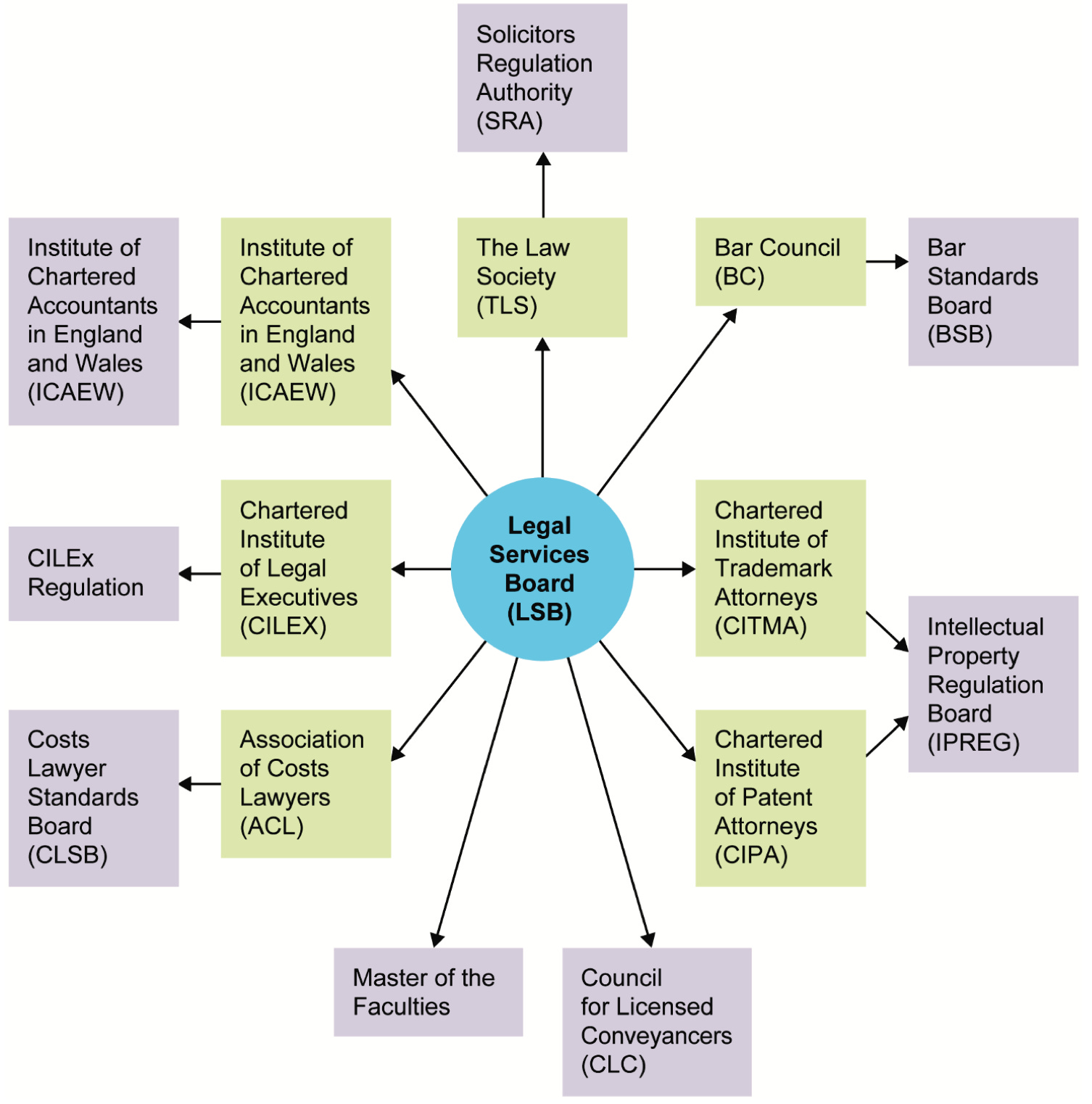
Lloyd found that the board’s oversight of the frontline regulators’ performance “has fallen short of what the government and parliament could reasonably expect”. As a result, he continued, “the interests of consumers have not been as well protected by the system as they might have been”.
That said, he thought the board should be capable of playing a more effective and influential oversight role “with the right changes”. He recommended
a major shift in the board’s culture and capabilities,
a clear separation of its enforcement function from its sector-wide convening work,
a renewed appetite for collaboration and
a shared understanding of priorities, risks and purpose.
That meant giving up work of less value. Lloyd spoke to several stakeholders who said the board’s focus on areas such as SLAPPs — Strategic Lawsuits Against Public Participation — illustrated a “tendency to pursue initiatives with limited practical impact and which may be more appropriately within the remit of parliament or the Ministry of Justice”.
Leadership
The Legal Services Board has found it difficult to recruit and retain leaders. In February 2025, Alan Kershaw suddenly stood down as chair after less than two years in the job, “citing personal considerations”.
His chief executive Craig Westwood, who had started work in August 2024, thanked Kershaw for his contribution.
In June 2025, Westwood handed in his own resignation, also “citing personal considerations”.

It took the Ministry of Justice more than a year to replace Kershaw as chair. Monisha Shah took up the job in April. She said yesterday:
Regulatory failures have resulted in significant consumer detriment. We accept our responsibility in the failure of the system to protect the interests of consumers. The public have a right to expect better outcomes from the legal regulatory framework…
This report gives us a clear, independent basis for a major reset. We will introduce a sharper regulatory focus and a more dynamic, risk-based approach to oversight, directing our work and resources towards issues which present the greatest risk to consumers.
This work has already begun. Planned changes include separating our enforcement and oversight function from our regulatory policy and engagement work.
We will build on this with a consultation in the autumn on a focused three-year strategy setting out our priorities. This will replace our current 10-year sector-wide strategy.
Successful reform, Lloyd concluded, “will depend on co-ordinated change at multiple levels: within the Legal Services Board, across frontline regulators, and within the Ministry of Justice as the sponsoring department”.
In his view, there was an urgent need for system-wide transformation rather than isolated organisational change.
The body that selects judges is trying to speed up its processes. “We believe there is always room for improvement” wrote Tom Cross KC, a barrister member of the Judicial Appointments Commission, on its website yesterday.
The commission “remains committed to exploring how best [it] can shorten the length of competitions to better meet the needs of the courts and tribunals but without compromising on their quality”, he continued.
“We recognise that the process asks a great deal of candidates and we are grateful for their patience whilst we look to make it better.”