
Room at the top
The person who’ll choose the judges has yet to be chosen

A piece I published just over a week ago turned out to be premature:
Another top judge announced his forthcoming retirement a day later and he turned out to be the toppest judge of all. Lord Reed of Allermuir will be stepping down as president of the UK Supreme Court, effectively at the end of this year.
Nobody could say he was leaving early. He will have served for seven years as president, for 15 years as a judge of the Supreme Court, and for 28 years as a member of the senior judiciary.
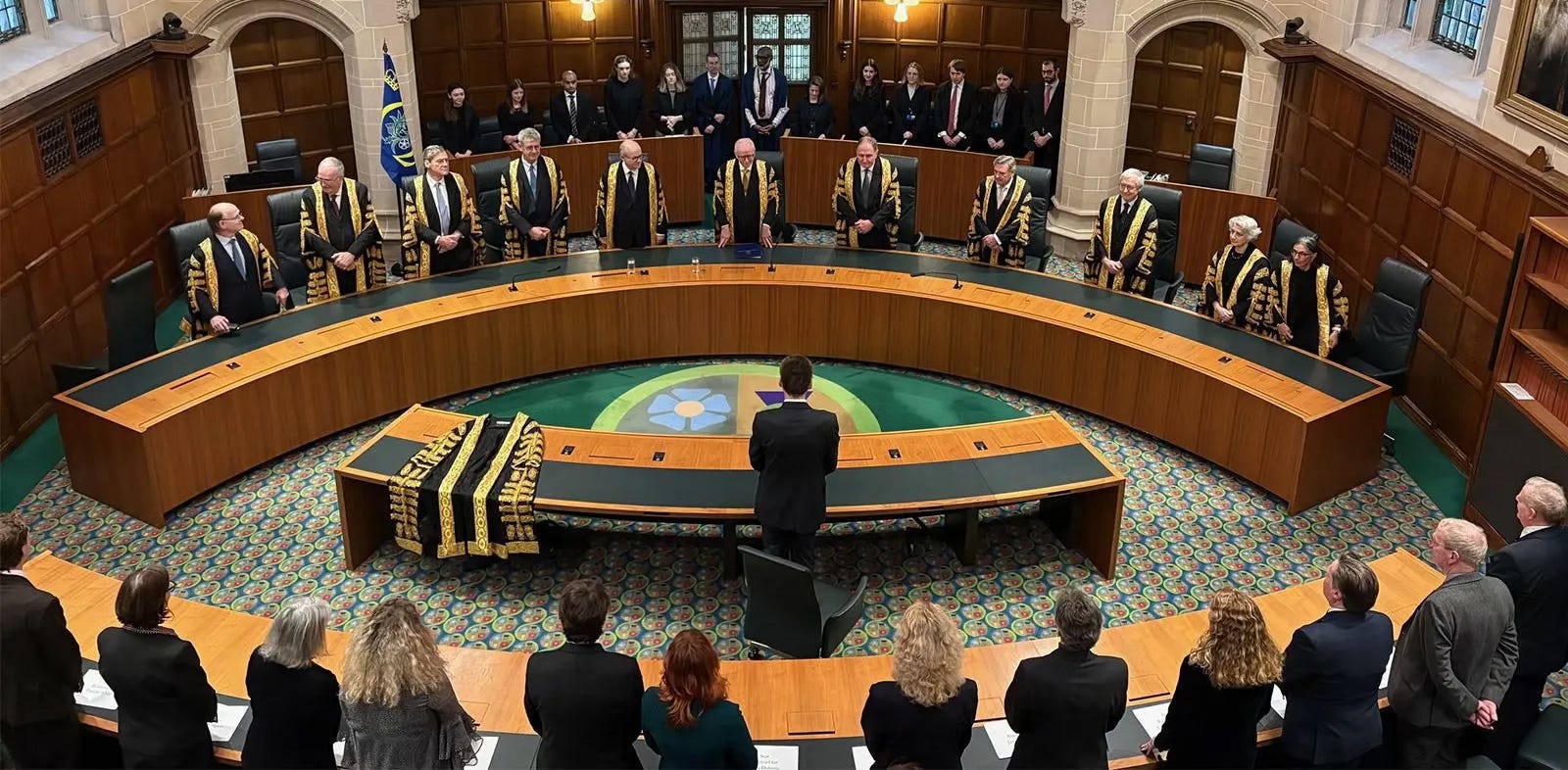
When we heard last October that Lord Sales would be taking over from Lord Hodge as deputy president this month, I observed that Sales would be well placed to take the top seat when Reed retired. To be frank, I didn’t think that would be quite so soon. Sales was Reed’s choice but could he succeed Reed after only a year as deputy president?
Some of us still remember Philip Sales as the barrister who became First Junior Treasury Counsel — “treasury devil” — at the precociously early age of 35. But that was getting on for 30 years ago. Others remember him as one of the three judges defamed by the Daily Mail as “enemies of the people” for holding that primary legislation would be needed to trigger Brexit. Even that was nearly a decade ago.
If Sales becomes president of the Supreme Court at the beginning of next year he will be a month short of his 65th birthday, older than Reed was on appointment but not too old to serve for a good half-decade or more before retirement. And Lord Irvine of Lairg, the lord chancellor who appointed him in 1997, will have been entirely vindicated.
This year, the Supreme Court will need to recruit at least three new justices (to replace Lord Richards, Lord Reed and Lord Lloyd-Jones). And the Court of Appeal will need to recruit three heads of division (to replace Sir Andrew McFarlane, Dame Victoria Sharp and Sir Geoffrey Vos). That, in turn, will create vacancies in the Court of Appeal. I don’t believe there has ever been such a far-reaching realignment of the senior judiciary in such a brief period.
The good news is that this is a matter of total indifference to the public at large. Judges in the United Kingdom, unlike their counterparts in the United States, are not known for their party affiliations. People may or may not respect the senior judiciary but most would find it difficult to distinguish one judge from another on the basis of their political views,
The bad news is that the person with ultimate responsibility for fitting the right half-dozen candidates into the right half-dozen positions has yet to be found. Indeed, the post has not yet been advertised.
I should explain immediately that the Judicial Appointments Commission for England and Wales does not appoint or promote justices of the Supreme Court. But the commission’s chair would normally be a member of the panel that does. And there will have to be close cooperation between the two appointments commissions to ensure that the same candidate is not appointed to posts in two different courts at around the same time.
Who’s to blame for leaving the Judicial Appointments Commission leaderless during the most important year of its existence? And what are the consequences likely to be?
Those are among the questions I discuss in my column for this week’s Law Society Gazette. To read it, click here, answer the cookies question and then click anywhere on the left-hand page.
Joshua,
We appear to disagree on whether there is a Welsh "seat" on the SC. Three reasons lead me to conclude that there is not. Firstly England and Wales has a unified legal system and Judiciary so in that sense every member of the Court of Appeal has "knowledge of, and experience of practice in, the law (of Wales)"
Secondly Lloyd-Jones was the first Welsh member of the SC and so there was no seat prior to 2017. Thirdly the SC website refers to the convention that "at least two justices are from Scotland and one is from Northern Ireland" but makes no mention of Wales.
Excellent piece
Once more Lammy falls short