
Rules are right
Attorney general defends UK’s military response to Iran war

The attorney general has argued that the UK’s response to the current US and Israeli military action against Iran is in Britain’s national interest.
In a lecture at the University of Manchester last night, Lord Hermer KC argued that respect for international law delivered a better outcome than what he described as a “might is right” approach to global affairs — presumed to be a reference to the US president’s policy, though Hermer made no mention of Donald Trump.
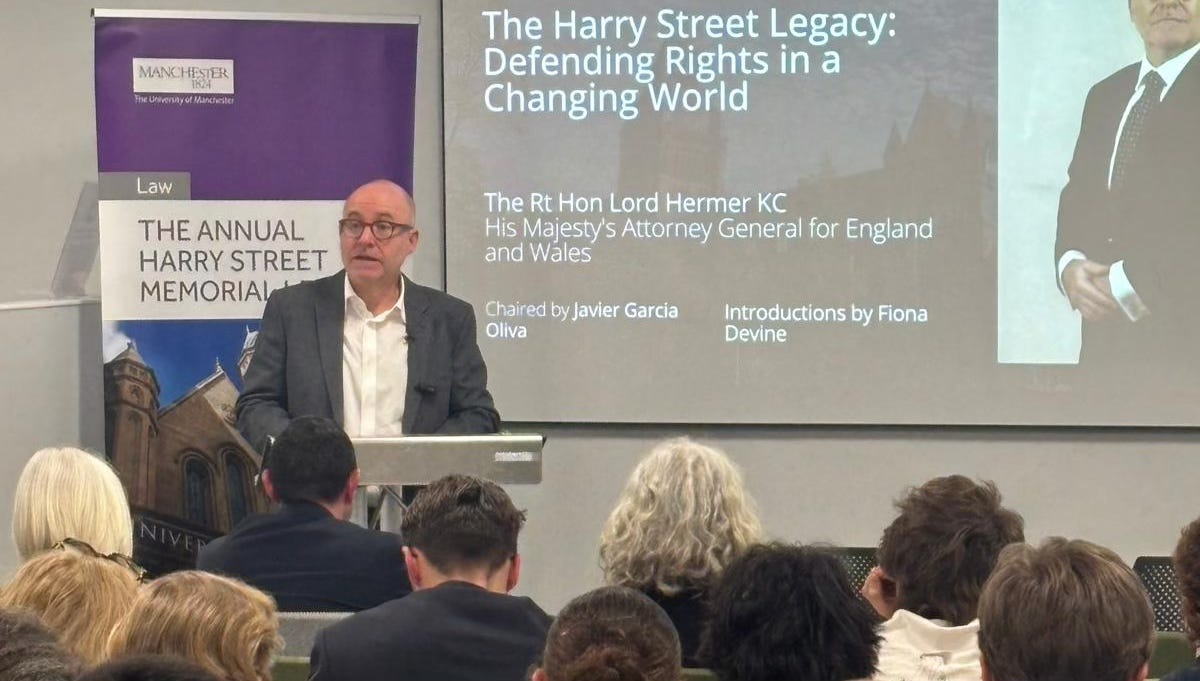
Hermer said:
As the prime minister has made plain, we need to learn lessons from the past — including the 2003 invasion of Iraq. In his steely assessment of the national interest, he sees international law as a key element in decision making.
If he had listened to the leaders of the Tories and Reform, unfettered by respect for legal frameworks or the complexities at play, we would have put planes and artillery into battle on day 1, only to seek to withdraw them on day 3. How would that have served Britain’s national interest?
By contrast, our position is clear: no to an offensive war; yes to defending ourselves and our allies from wanton and indiscriminate Iranian retaliation and escalation.
To a far-sighted strategic leader focused on a robust defence of their nation, international law should not be seen as a hindrance but as a sage guide.
Hermer, a graduate of Manchester university, was delivering its 38th annual lecture in memory of Professor Harry Street (1919-1984).
“Harry Street belonged to a generation that saw, first hand, what happens when laws are absent and moral restraints give way to violence and power,” Hermer told students.
“It was that generation that built the post-war settlement that we now call the rules-based international order,” he observed. “It was not despite the experience of the horrors of total war that they saw international law and its frameworks as the antidote to anarchy, but precisely because of it.”
Hermer said:
Disregarding the ethical implications for a moment, adopting a “might is right” approach to global affairs might theoretically work fine when we deal with weaker states. But it either requires us to accept that we will need to surrender our national interest whenever challenged by a stronger state or we must choose to ally ourselves so closely with a stronger state that we radically dilute our own sovereignty.
Neither option serves our national interest, nor is it consistent with our proud history as an independent sovereign state. It also simultaneously undercuts all the benefits that flow from our hard-earned reputation as a trusted leader in international law. Other countries want to work and trade with us because they know we keep our legal obligations, that we care about values and decency.
Our ancestors took that British sense of fairness and justice and wrote it into many of the precepts which are now considered fundamental in international law.
So my support for international law is not simply based on principle. It is about what it delivers in practice for this country and our national interest.
Shared rules make Britain more prosperous, allowing us to trade with confidence. They make us more just by underpinning protections for our citizens. And they make us more secure, by enabling cooperation with allies.
Secondly, a world without rules or where nations are free to walk away from their legal obligations is a world that pretty soon will descend into chaos — what Hobbes in a slightly different context would describe as a state of nature.
We know all too well what this can look like in practice. The price paid is human suffering and human misery. Today, as throughout history, it is always ordinary people who suffer most — rarely the leaders and their families.
Thirdly, compliance with international law serves the national interest because it helps guide and inform wise policy decisions. The compass by which any national leader navigates such stormy geopolitical waters such as the present conflict should be a clear-eyed sense of our own national interest. It is here that the international rule of law becomes so important because as leaders, as a nation, we are more likely to navigate these choices effectively, to reach the correct destination, if that compass is calibrated with regard to legal obligations.
Rarely does history look at major violations of international law and judge that it turned out well for the country that breached it. Did Argentina gain anything in its attack on the Falklands? Is the invasion of Ukraine working for Russia?
Hermer saw no inherent tension between belief in international law and human rights on the one hand and believing also that a strong military was an absolute necessity to protect us in a dangerous world.
Rejecting the position adopted by Zack Polanski of the Green Party, Hermer said:
It was military strength and valour that defeated Nazism. And the idea that in the face of the threat currently posed by Russia we should be leaving the Nato alliance is utterly reckless.
Russia is a country run by an oligarchy which has committed countless war crimes in the execution of its campaign, including abduction of thousands of children, and who if left unchecked will next present an existential threat to our Nato border allies.
So, it is not despite being a human rights lawyer that I passionately believe in the strength and professionalism of our armed forces. It is because of it.
When I was a student here, we were about to embark on an era of a peace dividend, when military spending reduced. Facing the world as it is today, not as we would want it to be, we have no other responsible choice other than to increase military spending. It is absolutely the right thing to do.
Withdrawing from Nato or reducing defence spending would be “a profound mistake”, he concluded.
Update 1530: a transcript of Hermer’s speech has now been published. Party names (such as “Labour”, “Conservative” and “Reform”) have been redacted, though readers should not have too much trouble filling in the gaps.
The international rules-based order will be discussed tonight by Professor Lord Verdirame KC in conversation with Professor John Bew CMG.
Such a shame " international" "law" doesn't apply to Jews. I'm not sure exactly how the concept of exclusion works. Is it perhaps that Jews do not come under the definition of 'people'?
On the other hand Starmer has always hidden his darker motives even at times when young children were being raped by Jimmy Saville, so his pignorance [sic] behind 'International Law' comes as no surprise.
Aided and abetted by people like Hermer ( who IMHO both deserve a special waxwork figure in a dedicated section at Madame Tussaud's called Those who destroyed the UK) no Jewish person can feel safe now.