
Safeguarding the constitution
And more ministerial changes at the Ministry of Justice

The United Kingdom’s uncodified constitution must be safeguarded if it is protect the integrity of our democracy, public policy experts argue in a report published today. They make 28 recommendations dealing with loopholes that could be exploited by unscrupulous governments as well as raising wider concerns.
The report, written for the UCL Constitution Unit by Lisa James, Professor Meg Russell and Professor Alan Renwick, has three aims:
ensuring that vulnerabilities in our constitutional arrangements are addressed;
enabling the UK’s constitutional and democratic structures to meet the needs and challenges of contemporary politics and society; and
supporting citizens to participate effectively in democracy in the complex modern world.
Constitution committee
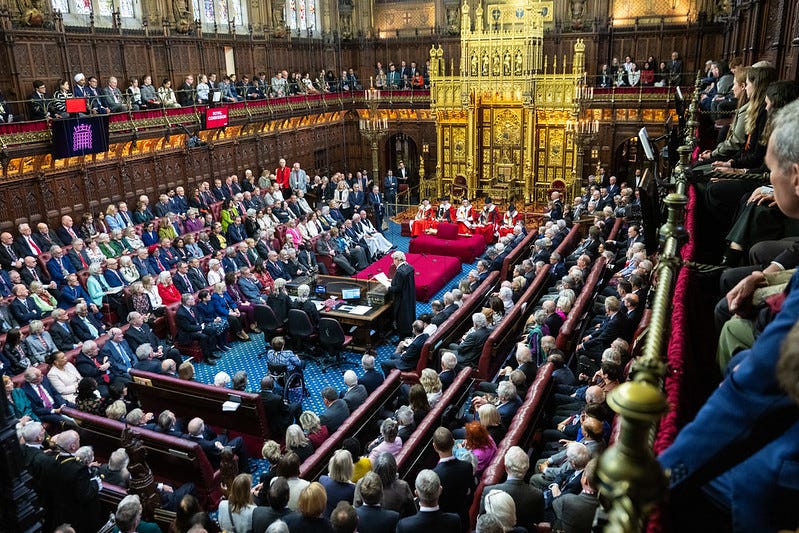
By a happy coincidence, the House of Lords constitution committee announced yesterday that it would be holding an inquiry along the same lines.
Lord Strathclyde CH, the committee’s chair, said:
Our constitutional democracy is something of which we are rightly proud in this country… At this present moment, however, there is a sense from many across the political spectrum that our constitutional democracy is facing a particularly acute threat, in which the safeguards that have served us so well in the past may no longer continue to do so.
In light of these concerns, the constitution committee is launching an inquiry to examine the threats to, and vulnerabilities of, our constitution. We will begin by scrutinising the effectiveness of the UK’s constitutional safeguards.
Strathclyde recorded a chatty social media video — “Hi, I’m Tom Strathclyde” — encouraging anyone with an interest in the topic to submit written evidence by 28 September.
Constitution Unit
Meanwhile the UCL Constitution Unit has proposed reforms intended to safeguard parliament, ensure respect for ethical rules and strengthen electoral law. This is how it summarised its recommendations:
Safeguarding parliament
The prime minister’s power to appoint to the House of Lords should be limited by introducing a cap on the size of the chamber and requiring fair political balance in appointments.
House of Lords Appointments Commission recommendations against nominees on propriety grounds should be made binding.
The House of Commons should be required to approve proposed prorogations and dissolutions of parliament.
The House of Commons should be given the power to recall itself from recess.
A confirmatory vote on the weekly Commons agenda should be introduced via changes to standing orders.
House of Commons standing orders should be amended to reduce government control over the allocation of opposition and backbench time and to ensure that the allocation of opposition time reflects the distribution of seats between opposition parties.
Improving scrutiny
A thorough review of the scrutiny procedures for delegated legislation should take place. Its recommendations should then be implemented by standing order and legislative change.
All bills that would benefit from it, including constitutional bills, should be subject to evidence-taking in a public bill committee in the House of Commons; parliament should monitor and report on adherence to this norm.
Public bill committees should be improved to encourage greater involvement from expert MPs, invitation of evidence from a wider range of stakeholders and greater deliberation.
The active consent of the House of Commons should be required in order to enter into, exit from, or substantially modify international agreements.
Protecting ethics regulators
The ethics regulators which currently lack it should be provided with a statutory underpinning.
A more robust appointments process that prioritises independence over ministerial discretion should be developed for key constitutional bodies.
Increasing transparency
Lobbying transparency rules should be made tighter and more consistent, through amendments to the Lobbying Act 2014.
Government transparency data should be published more regularly and in more accessible formats.
A new edition of the Cabinet Manual should be published, as promised by the Starmer government, and a process for regular future updating should also be established.
Parliamentary data on adherence to scrutiny standards should be proactively gathered and published in a central and easily accessible format.
Strengthening elections
Any review of the electoral system for the House of Commons should build in wide and deep public participation; and draw on expert analysis. Any final decision should be based on a clear indication of public consent.
The Representation of the People Bill should be amended to prohibit a single-party majority on the Speaker’s committee on the electoral commission, and to provide for the appointment of lay members.
Boundary Commission governance should be strengthened through formalising the Speaker’s non-participation in boundary reviews and requiring commissioners to be politically impartial.
The legislative framework for elections should be consolidated.
Updating political finance rules
A donations cap should be introduced, with the first step being a review to determine the correct level at which to set this for different types of donor.
The promised review of spending limits is welcome but should be carried out in parallel with work on donation caps. That exercise should seek to develop a fair and balanced system of political finance regulation that can command cross-party and public support.
Improving the information environment
The government should revisit the idea of online harms and require platforms to consider and mitigate democratic risks. Further measures should apply during election campaigns.
The law around deepfakes should be clarified.
The new BBC charter should task the organisation with supporting democratic health.
An independent democratic information hub should be created, with a limited remit at first.
School-based citizenship education and lifelong civic education should be regarded as a key element of creating a healthy democracy.
Relevant public bodies should seek to promote public understanding of UK democracy.
Comment
There can’t be many parliamentary inquiries that receive such a comprehensive set of proposals on the day they are launched. Perhaps the British constitution is not as vulnerable as it seems.
Ministry of Justice changes
Alex Davies-Jones MP, who resigned from the government in May, has returned to the Ministry of Justice as a junior minister.
Lord Lemos CMG CBE, who has been the faith minister at the housing and communities ministry for less than two months, has been appointed to the Ministry of Justice as a junior minister. He was a civil service commissioner from 2001 to 2006 and a non-executive director of the Crown Prosecution Service from 2006 to 2010. He was the lead non-executive director of HM Prison and Probation Service from 2018 to 2025.
Jake Richards MP will remain at the Ministry of Justice as a junior minister. He will no longer serve as assistant whip, the job for which he was previously paid.
Baroness Levitt KC has left the government after less than a year as a junior minister at the Ministry of Justice.
Catherine Atkinson MP has left the government after less than three months as a junior minister at the Ministry of Justice.
I reported earlier ministerial appointments yesterday.
Those leaving office particularly after a short period will get loss of office compensation. Those returning (Angie Rayner) do not have to repay.
I am a family lawyer with especial interest in children law (including asylum issues), child support (which crosses over into administrative law) and openness of family justice (or rather, often, the lack of it: what family lawyers call ‘transparency’).
Ten years ago the government set up a Family Court, but left fully on stream the more senior Family Division of the High Court. Family law was deliberately siloed from mainstream civil proceedings rules. The government set up under the President of the Family Division a committee to deal with rule making under which ‘family business’ (as it is called) in our family courts.
A couple of weeks ago (https://rozenberg.substack.com/p/lord-mackay-of-clashfern-kt?utm_source=post-email-title&publication_id=79530&post_id=205882345&utm_campaign=email-post-title&isFreemail=false&r=36y6s&triedRedirect=true&utm_medium=email) you wrote about Lord Mackay LC and how he managed to straddle the separation of constitutional powers in his dealing with the role of the Lord Chancellor: a member of the government (executive), a member and chair of the House of Lords and thus a legislator and, occasionally a judge. He well understood the law for which he was responsible as I explain at eg https://dburrows.substack.com/p/the-burrows-amendment?utm_source=substack&utm_campaign=post_embed&utm_medium=web.
The President of the Family Division still has similar undivided powers as did the former Lord Chancellor. These powers are concentrated in one office-holder, though on a smaller stage. Sir James Munby P was an often misguided – if highly determined – political operator with idiosyncratic legislative urges. He was a stranger to collaborative effort, as far as one can tell. Sir Andrew McFarlane P has minimal political skills (in my opinion) and in legislative terms his law-building is, I suspect, led by civil servants rarely by him (save sometimes in children law). Both were excellent judges; but their remaining powers – legislative and executive – were minimal and uneven, to the increasing poverty of family law.
And the rule-making for family proceedings? Parliament’s attempt to delegate regulation of family courts is left mostly to a committee of judges, whose job is judicial. Their job cannot be legislative (rules in this case); though of course they may have important advisory capacity to guide rule makers.
All this is of constitutional import. Whether it will be on the constitutional committee's radar I do not know....