
Terror group fights on
But where does it go from here?

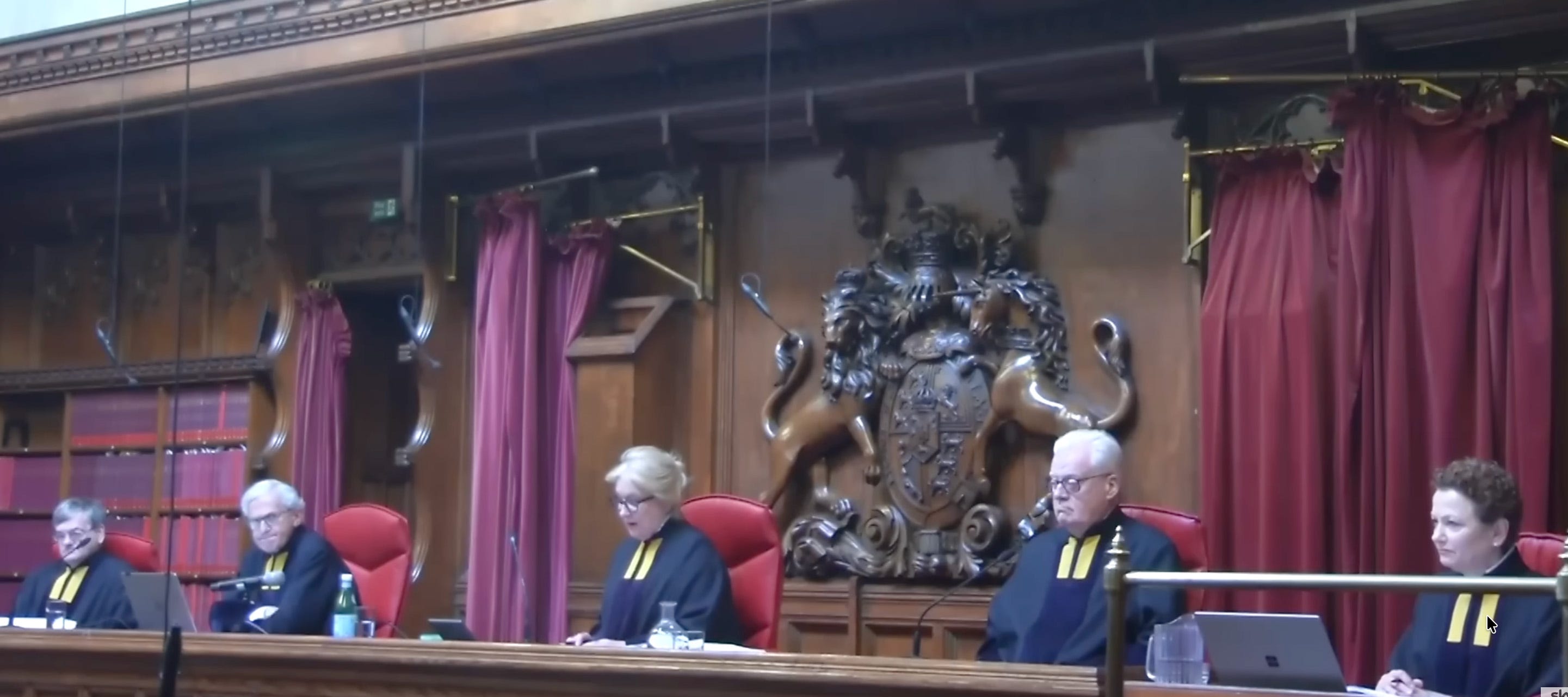
The co-founder of Palestine Action told the Guardian this week that the group’s battle to overturn its ban as a terrorist organisation would be won in the courts or on the streets. But if the group had simply campaigned on the streets, it would not have been banned in the first place. And if Palestine Action had not broken into an RAF base a year ago and disabled two aircraft — normally used for operational support, medical evacuation and disaster response — the Court of Appeal might not have upheld the home secretary’s proscription order in the judgment it delivered on Monday.
Does Huda Ammori have any chance of winning in the courts now? And where does the ruling leave well over 3,000 people who have been arrested on the streets? Those are among the questions I address in my column for today’s Law Society Gazette. To read it, click here and then click anywhere on the left-hand page.
A week ago, four Palestine Action activists were given substantial prison sentences after a retrial. Their first prosecution had ended without convictions on any charges. What does that tell us about the state of jury trial in England and Wales?
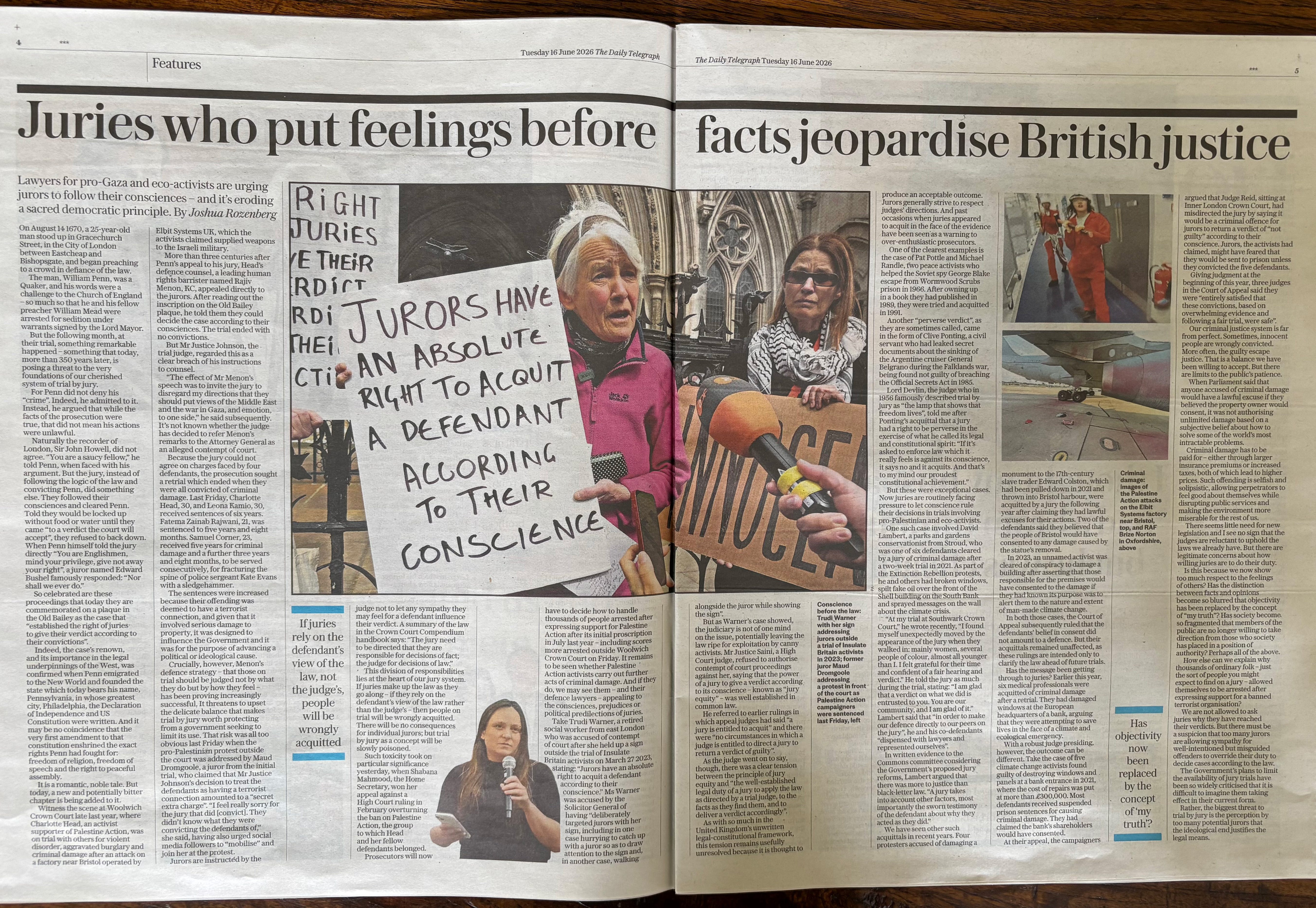
On Tuesday, the Telegraph published a lengthy essay in which I explored this issue. You can read that, too, online.
I make the point at the end of the piece that the government’s planned jury reforms are unlikely to take effect in their present form. We now know that the Courts and Tribunals Bill’s third reading debate will not be held until July at the earliest. Andy Burnham’s decisive victory in Makerfield makes it less likely that the reforms will take effect at all.
" JURIES WHO PUT FEELINGS BEFORE FACTS JEOPARDISE BRITISH JUSTICE"
SO Joshua..............tell me again how "victim ideology" doesn't already play a daily role in the so-called British "justice" system and has done so for decades?
Good morning. Your excellent articles this morning reminded me that I meant to write a note to you after your elegant and careful analysis of the sentencing of the PA defendants, from which you have no doubt moved on, but which took me some time to absorb.
The detail is above my pay grade, but I wonder if I could make two general observations that we could bear in mind going forward.
The first is that sentencing has become very complicated, and that level of complexity is an obstacle to transparency and everyone just understanding what has gone on.
One ought to be able to follow the sentence for a fairly simple matter of damaging a factory (to say nothing about the wicked injuring of a police officer) without having to re-read the sentencing remarks of a high court judge twice and then read your analysis to understand it.
The second general point is that I wonder if the law hasn’t become preoccupied with terrorism, and a very broad definition of it, that is leading nowhere. I think much of the legislation was drafted to deal with the problem of the IRA, where there were people too close by half to a campaign of bombing buildings (sometimes with tragic results for young lives). I'm not sure it was a great success then, and it is becoming more problematic the longer this goes on.
Most of us understand that blowing something up is a wicked crime, without any aggravating factors. If a defendant does it because he is motivated by racial or religious hatred, that is an aggravating feature because that strikes at the fault lines of our society. If he does it to remove the government, that also strikes at the heart of society and is effectively what used to be called treason.
However, very few people instinctively think that blowing something up in an effort to change government foreign policy is a serious aggravating feature. In this context, it is important to remember that most people regard the sale of arms to Israel as an arcane question of foreign policy about a country of which they know little and care even less. Many people are probably slightly uncomfortable about many of the countries to which we sell arms.
A few straightforward examples make the point. Who really imagines it is a serious aggravating feature if I commit a crime- to persuade the government to make a greater effort to defend Ukraine? Or to persuade the government that it shouldn't defend Ukraine, but allow it to become part of "Mother Russia". Or because I believe the government is doing too little to promote freedom for Tibet?
And if the answer is "hardly anyone", why are we going down this path?