
The shortest act?
Parliament redefines ‘thing’

Is this the shortest act of parliament?
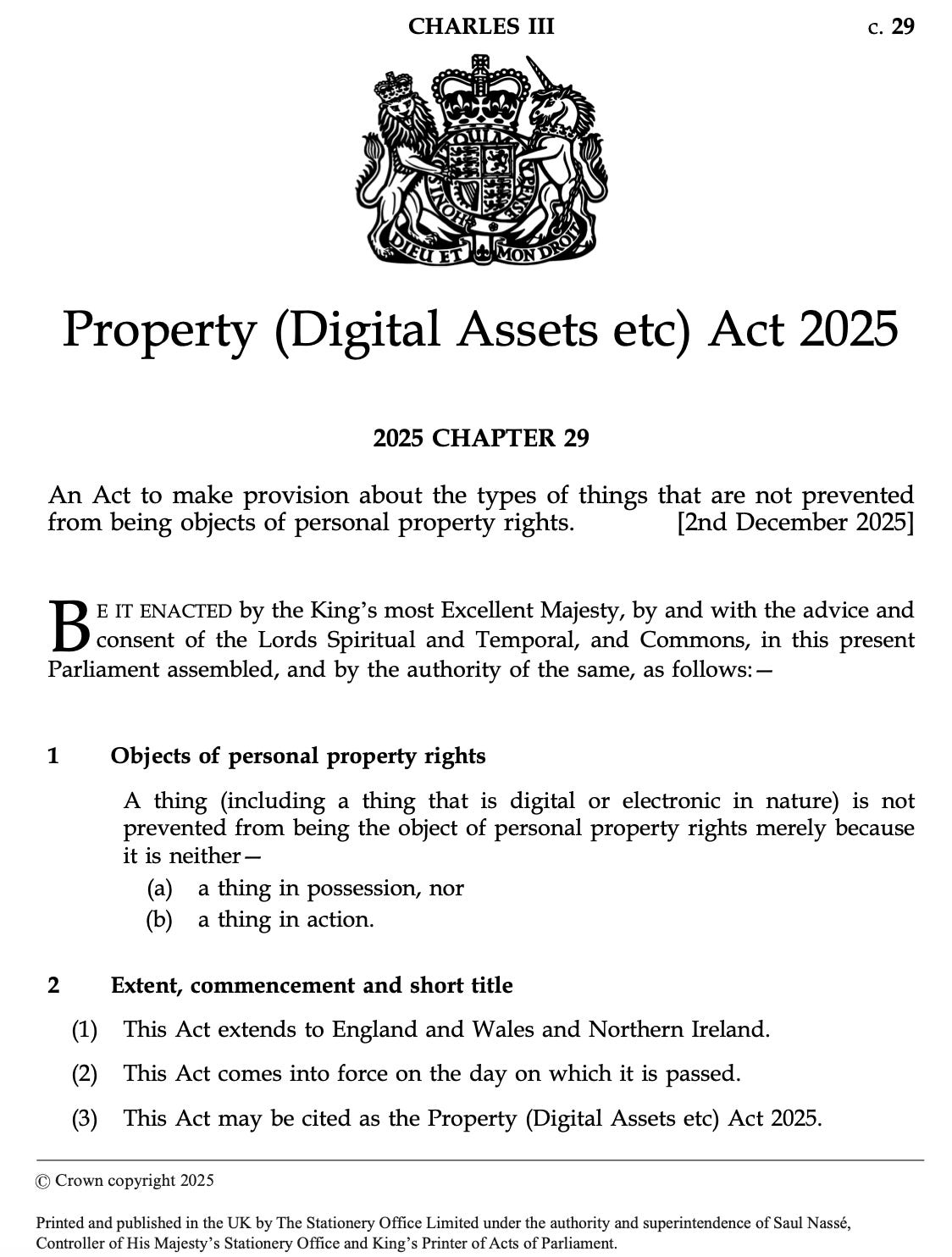
Probably not the shortest — although it must be one of the shortest, as the master of the rolls said at an event to celebrate the legislation last week. But what does it mean?
“In essence,” said Sir Geoffrey Vos, “it removes the legal uncertainty that was previously thought to exist as to whether digital assets would or would not be held to be a species of property under English law.”
Needless to say, it took a long time to produce something as short as this. Responding to a ministerial request, the government’s law reform advisers began work in 2020. Professor Sarah Green and her team at the Law Commission published a call for evidence in 2021; a consultation paper in 2022; a final report in 2023; and a supplemental report in 2024, including a draft of the bill that was passed by parliament with all-party support last year.
This is how the bill was introduced by the courts minster Sarah Sackman during its committee stage in November:
For centuries the law has drawn a simple line: personal property was either a “thing in possession”, that being a physical object such as a car or a watch, or a “thing in action”, something that exists because the law says it does and is enforced through legal action, such as a debt or a contractual right.
However, the world has changed. Technology has leapt forward, and our law must keep pace. Today we have assets such as crypto-tokens. They are not physical objects, yet their existence is not reliant on the law. They do not fit comfortably into either of the traditional categories.
The legislation, she explained, “provides a clear and powerful statement: that a thing — including something digital or electronic — can be recognised as personal property, even if it does not fall within either of the categories that our legal system has traditionally recognised.”
Sackman continued:
Our courts have begun to acknowledge that such assets can and should be the subject of property rights, but without a clear, binding legal foundation, uncertainty remains — uncertainty that could stifle innovation, deter investment, and push the digital economy elsewhere…
By removing ambiguity, clause 1 ensures that those who hold or transact in digital assets are better supported to defend their property rights, transfer them and recover them when it matters most…
To be clear, clause 1 does not attempt to draw rigid lines around what qualifies as property — that is a deliberate choice. It rightly empowers our courts to continue developing the common law, case by case, applying centuries of legal wisdom to the frontiers of a digital economy.
The reference to “digital or electronic things” in the bill simply reflects where the issues most commonly arise today, without boxing in where the law might go tomorrow. The clause paves the way for fairer outcomes in cases of theft, fraud, commercial dispute or insolvency involving digital assets. It will reduce litigation costs, promote market stability and underpin our reputation as a jurisdiction of choice in a digital world.
This is a small clause with big consequences. It is a bold, forward-looking step that reaffirms our commitment to legal certainty, technological progress and global leadership.
La même chose
For readers of a certain age and those from other common law jurisdictions, I should explain that what we’re talking about used to be called a “chose in possession” or a “chose in action”.
It’s the same thing.
Readers of my report last Friday about the government’s preferred candidate for chair of the Legal Services Board may be interested to know that I have updated the piece with some more questions that the justice committee may want to ask Monisha Shah when she gives evidence to MPs next week.
It may not be the shortest Act of Parliament, as Andrew Turek has noted in his comment, but Lord Rodger of Earlsferry's concurring eight-line opinion in R v Bentham [2005] 1 WLR 1057, para 14 at p1062C, must be one of the shortest reasoned opinions/speeches.
The 'short question' for their lordships to decide, as put by Lord Bingham at the beginning of his opinion (para 1, p1059B), was: "Can a person who has his hand inside a zipped-up jacket, forcing the material out so as to give the impression that he has a gun, be held to have in his possession an imitation firearm within the meaning of section 17(2) of the Firearms Act 1968?"
This was Lord Rodger's answer:
"Dominus membrorum suorum nemo videtur: no-one is to be regarded as the owner of his own limbs, says Ulpian in D.9.2.13. pr. Equally, we may be sure, no-one is to be regarded as being in possession of his own limbs. The Crown argument, however, depends on the contrary, untenable, proposition that, when carrying out the robbery, the appellant had his own fingers in his possession in terms of section 17(2) of the Firearms Act 1968. I agree with my noble and learned friend, Lord Bingham of Cornhill, that for this reason the appeal should be allowed."
One's own finger, therefore, is not "a thing in possession"!
Parliament (Qualification of Women) Act 1918:
A woman shall not be disqualified by sex or marriage from being elected to or sitting as a Member of the Commons House of Parliament.
Or then there is A. P. Herbert’s Act:
If anything shall seem
The Minister may deem.
His certificate of demption
Shall confer complete exemptions.