
Artificial judges
And artificial constraints on international law

Lawyers applying to become judges in England and Wales can now use artificial intelligence to improve work they have already written. But they have been warned that using AI in qualifying tests could result in disqualification from future judicial appointments and disciplinary action by their regulators.
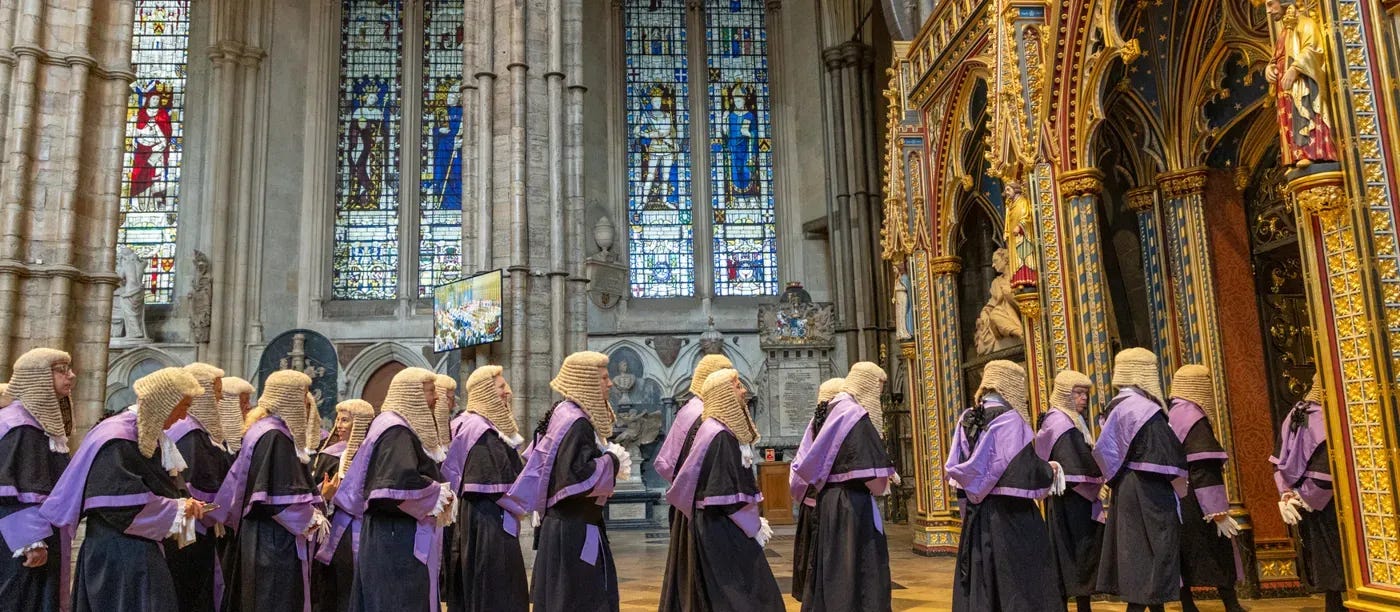
Guidance published by the Judicial Appointments Commission this week says AI “may be used by candidates when drafting and reviewing self-assessment or individual skill and ability examples, provided the individual remains fully responsible for the accuracy and truthfulness of all material submitted”.
AI OK
Acceptable uses of AI include
improving grammar, clarity and structure of self‑written examples;
identifying key themes or strengths in the content already written;
assessing a self‑authored draft for coherence and identifying narrative gaps; and
summarising long documents that the candidate has personally authored.
AI can be used to enhance readability and structure, the commission says, but it must not create substantive content or inaccurately overstate personal experience.
AI not OK
Candidates must not use AI in any qualifying test, selection day or other live assessment. That means not using AI to
draft, generate or refine answers to test questions;
produce responses for situational judgement, critical analysis or scenario-based assessments;
suggest solutions, explanations or interpretations of legal or factual questions ; or
help make decisions during a timed or supervised assessment or interview.
Comment
If judges are allowed to use AI when preparing their judgments — as they are — then it seems reasonable to let applicants use it, under similar constraints, when applying for judicial appointments.
But I wouldn’t risk it myself. The stakes are far too high. Matthew Goodwin, the Reform candidate who came second in the recent Gorton and Denton parliamentary by-election, has denied using AI to write his new book. The accusation is not as serious as an allegation of plagiarism but it comes a close second.
So let me assure readers that I write every word of this Substack myself. I use AI to help me find primary sources without worrying too much whether my search engine is Google, ChatGPT or the little window at the top of my browser. But there are still some of us around who were trained to write clear, simple English. And for as long as we feel we can write better than a machine, we shall carry on doing so.
Iran and international law
In a speech I reported yesterday, the attorney general argued that the UK’s involvement in military action against Iran was consistent with international law. Lord Hermer KC said the government’s position was clear: “no to an offensive war; yes to defending ourselves and our allies from wanton and indiscriminate Iranian retaliation and escalation”.

Professor Lord Verdirame KC, the non-affiliated peer and international lawyer, said last night he was not persuaded that the government’s published legal position on the Iran war was entirely sound — either legally or strategically.
Speaking at the think tank Policy Exchange, Verdirame said:
As with the Cuban missile crisis, this is not the first time a British government has had to balance legal obligation with statecraft. Other Western leaders, including prime ministers Carney and Albanese and chancellor Merz, have struck that balance.
In his RUSI speech last year, the attorney general said that “our international obligations are not onerous but manifestly in this country’s national interests”. It is here, again, that I detect a degree of ideological inclination. No company would suggest that all its legal or contractual obligations are invariably in its interests. It depends; sometimes they are not. Starting from such a Panglossian premise risks overlooking the need for careful and often difficult judgement.
Second, having implied throughout that there was no case to be made about an imminent attack from Iran, the government’s statement said that, over the last year alone, Iran had been responsible for “more than 20 potentially lethal attacks on UK soil”. If there have been 20 foiled attacks in one year, does that not make a twenty-first one imminent?
That statement also said that Iran’s drone attack against the RAF Akrotiri base in Cyprus “was launched prior to” the announcement that Britain would join the operations in a limited role, which implies that the previous day an attack was indeed imminent.
Third, and most importantly, I have reservations about how government set out the position on targeting. The government says the legal basis for the British intervention is the collective self-defence of allies in the Gulf and that means we are only permitted to target missiles and drones launched by Iran, and the missile facilities. On 20 March, the government extended the targeting to Iranian capabilities used to attack shipping on the Strait of Hormuz.
Once an armed conflict has begun, the law of armed conflict allows the targeting of all military objectives, which includes, at a minimum, all military personnel and all weapons. The UAE alone has been attacked with hundreds of ballistic missiles and over 2000 drones.
Ten days ago, I asked the government in parliament whether they were really suggesting that a state that has come under such an attack can only target in response the specific weapons used against it, but that it cannot, for example, shoot down an Iranian fighter jet.
The problem is that the government presented its decisions on targeting not just as policy but as dictated by law. This was not a case of strategic self-restraint. The message was not: “we could do more, but we are not yet”. The message was: “this is all international law allows us to do”.
The more recent statement is more carefully phrased. But for the first 20 days of this conflict, we conveyed the impression to allies and adversaries that our legal approach to targeting in armed conflict has become far more benign than in the past and, in my view, than the law requires.
I believe it risks leaving us dangerously exposed to what comes next — the more so if, as it seems right now, the Trump administration has miscalculated.
Earlier, Verdirame had argued that international law was not, as Hermer liked to call it, a “lodestar” — something that was fixed, constant and beyond our reach.
The British tradition was to treat international law as something they had to shape in accordance with British values and interests, he said:
Britain’s campaign against the Atlantic slave trade in the 19th century is a textbook example of shaping international law to fit strategic and moral aims. With no peacetime right to stop or search foreign vessels, Britain had to develop legal foundations for its policy. It did so by often adopting interpretations that government lawyers these days would describe as very “forward-leaning”.
A more recent example is the development of the customary rules on special‑mission immunity. For two decades, Foreign Office lawyers worked with counterparts abroad to consolidate the state practice supporting those rules. When the case came before our courts — I was counsel for the Foreign and Commonwealth Office — we could show the existence of the customary rules by pointing to this practice.
Another example, the lawyer concluded, was Tony Blair’s speech in Chicago at the beginning of the Kosovo war, where the prime minister set out the conditions under which Britain was prepared to use force for humanitarian purposes.
“The doctrine of ‘humanitarian intervention’ was and remains very controversial in international law,” said Verdirame. “But the then British government considered that such a doctrine was in the British national interest— and made the case for it.”
Monisha Shah
Monisha Shah, the government’s preferred candidate for chair of the Legal Services Board, will appear before the Commons justice committee this morning for pre-appointment scrutiny.
In a post two weeks ago, I set out some of the issues that I hope MPs will raise with her.
Is it desperately naïve or utopian of me to hope that judges might be able to call on the resources of their own brains when "improving grammar, clarity and structure of self‑written examples;
identifying key themes or strengths in the content already written; assessing a self‑authored draft for coherence and identifying narrative gaps; and summarising long documents that the candidate has personally authored."?
Is it unduly pessimistic to think that potential judges who choose to outsource these vital aspects of thinking might be ill-suited to the role?
Kate has said it all. Are not judges expected to be educated, literate, clear thinking, organised and articulate amongst other qualities? Any judge who has used AI (for any purpose) should be expected to disclose that in his judgment.