
Complaining about judges
Are time limits being interpreted too strictly?

A leading feminist barrister is considering bringing legal action against the Judicial Conduct Investigations Office over the way it handled a complaint against a circuit judge. Dr Charlotte Proudman’s potential claim is based on anonymous comments made about her on Twitter (as it then was) in 2022. She claims the tweets were misogynistic, offensive and intended to bully her.
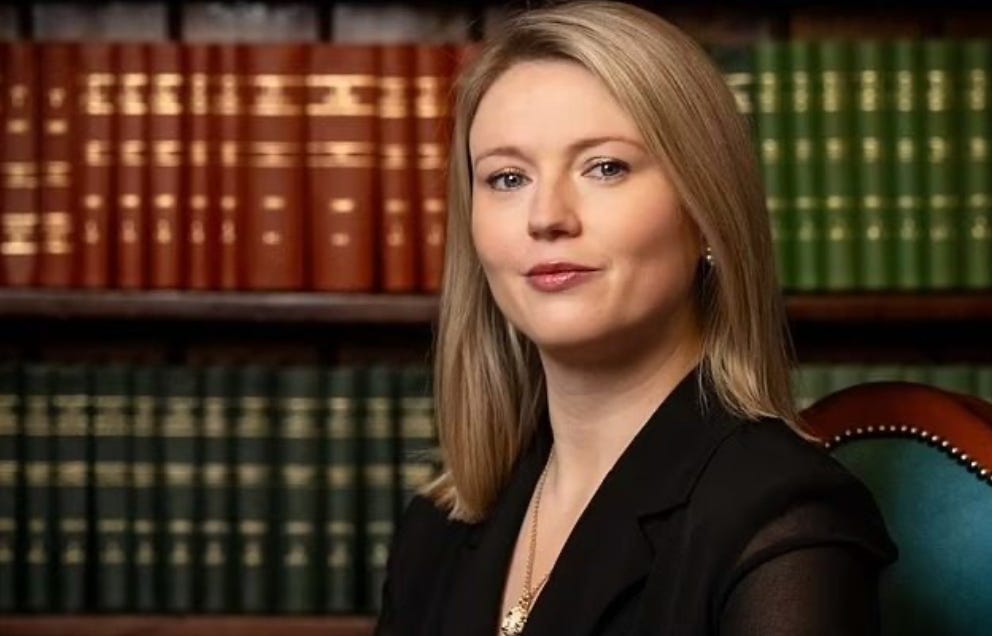
The complaint was lodged with investigators last June by one of Proudman’s colleagues at an equality campaign group that she founded and now co-directs. It says the tweets were published by Daniel Sawyer, who became a full-time judge on the western circuit in 2024 after four years as a part-time recorder. He is correctly referred to as HH Judge Daniel Sawyer to distinguish him from HH Judge Sawyer, appointed to the south-eastern circuit in 2023.
The Judicial Conduct Investigations Office supports the lord chancellor and the lady chief justice in their joint responsibility for judicial discipline. It works under the Judicial Conduct Rules 2023. Rule 12 says “a complaint must be made within three months of the matter complained of”.
Proudman’s colleague claimed to have complied with that time limit by complaining about Sawyer within three months of learning that he was responsible for the tweets. The complaint was formally accepted on 31 July 2025 and referred to a nominated judge for consideration.
According to the complainant, “that decision was reversed owing to an unannounced and inexplicable change in practice by the Judicial Conduct Investigations Office”. Proudman’s colleague was told that, under its revised approach, complaints had to be made within three months of publication.
An extension can be granted to the three-month time limit, but only if the investigations office considers that there are exceptional circumstances. Those put forward on behalf of Proudman were dismissed last December.
Judicial review
With a view to bringing judicial review proceedings, Proudman’s colleague sent a “letter before claim” to the judicial conduct office on 1 March. A detailed response was sent on its behalf last week by the Government Legal Department
The response disclosed that the investigations office had been advised by the nominated judge that it had no jurisdiction to accept the complaint against Sawyer because it had not been made within three months of anything he was said to have said or done. “Rule 12 does not say that a complaint must be made within three months of the complainant becoming aware of the matter complained of,” the unnamed judge observed.
Government lawyers explained that in the light of these observations the judicial conduct office “identified that an error had been made in initially accepting the complaint”. As a result, the office had “acted in excess of its jurisdiction”.
The complainant had been told in December that the caseworker — who by then was no longer working at the judicial conduct office — “had misapplied the time limit and sought to rectify this through their subsequent correspondence”.
That was a reference to a letter sent by the caseworker on 18 September. It said:
The JCIO has recently reviewed, and as a result revised, its approach to assessing whether complaints about social media activity by judicial office holders are made within the three-month time limit specified by rule 12 of the Judicial Conduct Rules 2023.
Based on the information available, it appears that HHJ Sawyer has not posted any posts relevant to the allegations since October 2022. As such, your complaint falls outside the time limit prescribed by the rules and we regret to inform you that we are unable to proceed with an investigation. We sincerely apologise for any confusion or inconvenience this may have caused.
The Government Legal Department letter said:
As has been explained, the original acceptance of the complaint was in error. JCIO had no power to accept the complaint without first inviting representations on the question of exceptional circumstances and then concluding that there were exceptional circumstances.
This was explained in the correspondence provided on 18 September 2025. However, having reviewed the correspondence of 18 September 2025, it could have been set out with greater clarity. Subsequent correspondence on 15 December 2025 identifies that the caseworker had made a mistake and the complaint had been mishandled.
An unfortunate inference also arises from the 18 September correspondence — that there had been a substantive change of policy at JCIO in relation to when it can investigate a matter under Rule 12 of the Judicial Conduct Rules 2023…
There is no reference within rule 12 or the wider rules to concepts of “awareness” or “discovery”. The absence of such language in the rules indicates that the limitation period should be measured from the date of the act in question rather than when an individual became aware of the act.
This provides a limit to the scope of JCIO’s power. The proposed defendant accepts the language used by their caseworker in the correspondence of 18 September 2025 was unclear and recognises the erroneous inference that could have been drawn. It is a regrettable imputation that the JCIO had changed its policy when it has not done; JCIO apologises for this, and any resulting confusion caused.
Later, the letter added:
At the point it referred the matter to the nominated judge for consideration, JCIO had acted in a manner outside of the scope of its powers and made an unlawful referral. This is regrettable and the apology of JCIO is once again repeated.
The Government Legal Department disclosed that, even so, the judicial conduct office had considered the substance of the allegations “in the interests of transparency and attempting to assure the proposed claimant that their complaint had not been dismissed out of hand”.
It ultimately formed the view that that the conduct alleged did not meet the threshold for disciplinary action. Three of the five allegations were “misconceived”. Even if the alleged facts in the remaining two allegations were true, they would not require a disciplinary sanction to be issued.
More generally, said government lawyers, a judicial review claim would now be out of time. The proposed grounds of challenge would either be resisted, denied or were bound to fail.
Response
Proudman told me yesterday:
The Judicial Conduct Investigations Office is not fit for purpose. They originally accepted the complaint because they accepted the conduct could amount to misconduct and referred it to a nominated judge.
The judge then seemingly asserted that the JCIO had acted unlawfully and changed when the three-month time limit ran from — treating it as running from when the tweets were posted rather than when they were seen. This appears to amount to the JCIO unilaterally altering its interpretation of the rules without transparency and public consultation.
They then dismissed the complaint, while also asserting that the conduct would not amount to misconduct in any event, without a proper investigation. The Government Legal Department’s apology for the poor handling of the complaint is not good enough.
Comment
Government lawyers told Proudman’s colleague that the scope of the investigation office’s powers had not changed. There was a “hard-edge limit to its power to investigate that cannot be altered or amended by the correspondence of an individual caseworker”.
The allegation in the letter before claim of “procedural impropriety through retrospective application of revised policy” — that the investigation office had attempted to manipulate the system in order to avoid addressing the serious misconduct complained of — was “an incredibly serious allegation and one that is entirely denied”, government lawyers added.
But what of the time limit itself? If an unacceptable comment about me is published by an anonymous part-time judge, should that judge escape all disciplinary sanction because I cannot identify the author within three months? Should a named judge get away with breaking social media guidance if nobody notices quickly enough or bothers to complain?
By coincidence, the High Court gave judgment yesterday on claims by individuals who alleged they had been unlawfully phone-hacked or targeted by journalists working for the Mirror group of newspapers. The Limitation Act 1980 says, in summary, that where facts relevant to a claim are deliberately concealed by a defendant, the six-year limitation period for issuing a claim does not start to run until the claimant knew the facts or could have discovered them with reasonable diligence. What Mr Justice Fancourt had to decide was whether, on the facts, any of the five claimants who brought test cases could rely on this exception to justify their delay in bringing claims.
This strikes me as a much better approach. If I could not with reasonable diligence have discovered the identity of the hypothetical anonymous judge within three months, surely the time limit should begin to run from the day I was tipped off?
The Judicial Conduct Investigations Office must strike a balance between the rights of judges and their obligations to the public. In this case, the complaints against Sawyer did not meet the threshold for disciplinary action. But there may be future cases where a broader interpretation of “exceptional circumstances” is the better response when a valid complaint appears to have arrived too late.
Apart from suggesting the issuing of handbags to every self-publicist and lawyer who has a non-lawyerly gripe, but only to those who might not already have one for reasons of parsimony, I have the following profound point to make. How would it work to say the three months should be interpreted from when someone became aware of the thing they're complaining about? Rule 12 seems clear: "a complaint must be made within three months of the matter complained of”. The matter is the tweet. There seems no other coherent way of reading it. If "the matter" were the point at which the complainant became aware it would make no sense since that can hardly be the thing that's being complained about. The implication of the piece, intentional or otherwise, is that the drafters made a mistake or were ambiguous about meaning of the 3 months. That seems implausible to me. They clearly wanted to create a time limit since they inserted one, perhaps for reasons of practicality of follow-up or to prevent trawling through ancient tweets. They could have said a year or 5 years if they'd wanted to allow for people to have a long time to spot it. The most plausible interpretation is that they felt that 3 months was long enough. That's an intent, not an error. As it is, it's perfectly reasonable to argue that the period should be extended but it seems absurd on its face to claim, as the "leading feminist barrister" does, that the rule has been misapplied or that corruption is involved.
The JCIO and JACO are corrupt (fail to uphold the Rule of Law) in my experience. They are not investigating ‘conduct’. I haven’t looked at it for some time but as I remember, Conduct is not defined in the Act. There are common law rules for interpreting ACTS and it isn't defining a term like ‘conduct’ as what you feel like, for example, swearing or racial abuse. Judicial Conduct is actually defined by Guide to Judicial Conduct by, of all people, the Judiciary of England and Wales. But try using that on JCIO and JACO. They disregard it for no lawful reason. They are operating in Breach of Statutory duty and are a key part of a corrupt Judiciary and corrupt Civil Justice System.
JCIO told me that the appropriate way to challenge a judge’s decision or management of a case is through the appellate process. This is misleading. If a judge’s conduct is contrary to, Natural Justice or Fraud, (lack of Impartiality, Integrity, or Propriety or Diligence [as defined in Guide to Judicial Conduct]) the decision is void, and the appropriate way to challenge it, is to apply to Set it Aside Ex Debito Justitiae. You should be able to do this via the JCIO, if you cannot do it via the courts because you can’t get a fair hearing in the courts.
JACO just said, that the JCIO followed their procedures, but I was challenging their procedures by the Rule of Law. If I recall correctly, JACO refused to correspond further, so my allegations are inferred as agreed. It is time this corrupt department was sorted out.