
Intelligence v Independence
AI could undermine the judiciary, a senior judge fears

One of the most senior judges in England and Wales has given a warning about the risks to judicial independence of artificial intelligence. Dame Victoria Sharp, who retires this summer as president of the High Court King’s Bench division, said that “if AI tools used in courts are designed, procured, funded and evaluated primarily as instruments of efficiency, the risk is that the constitutional function of the judiciary will be subordinated to managerial objectives”.
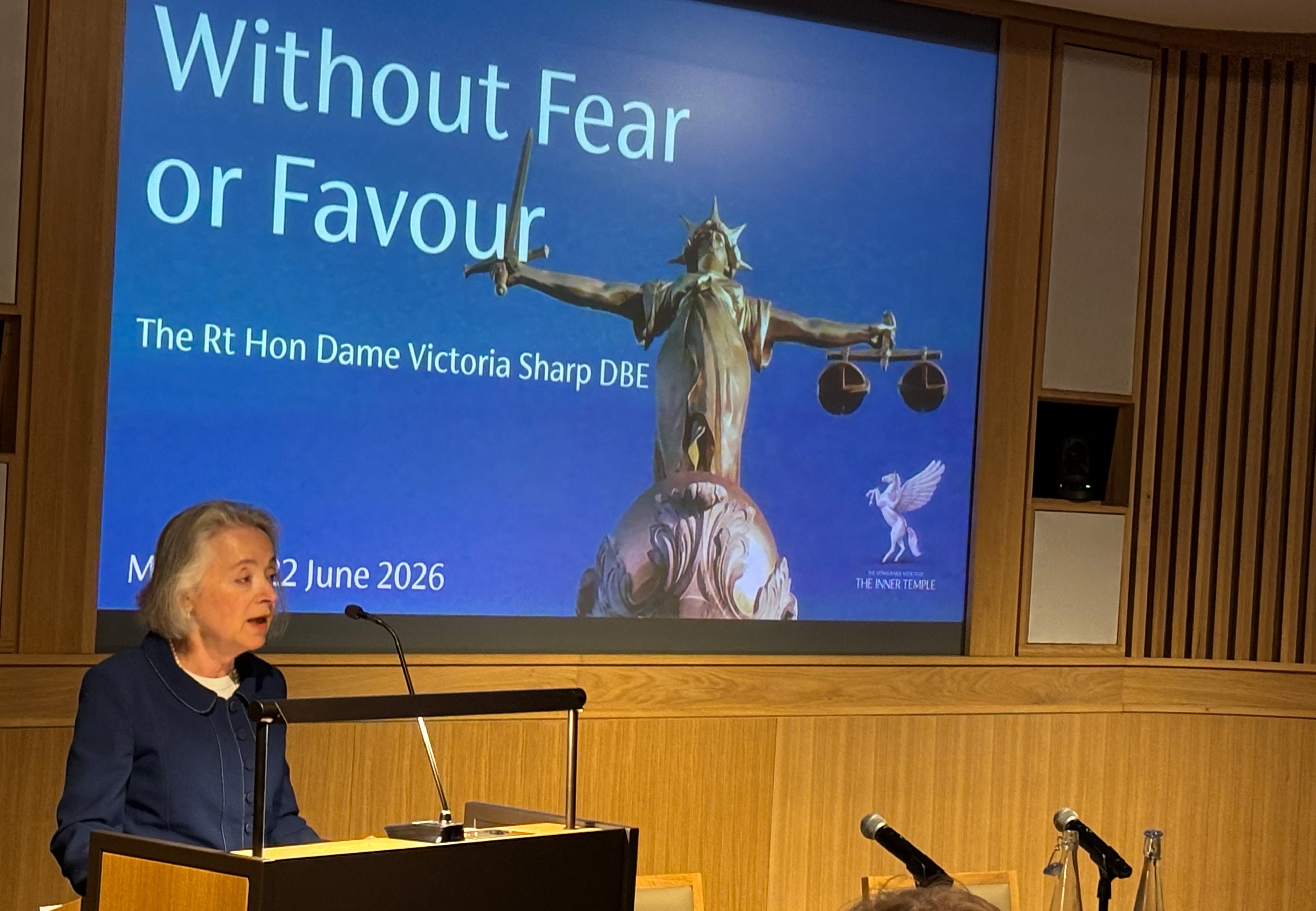
In a lecture last night at Inner Temple, Sharp offered a technical explanation of what AI does — and what it cannot do. She said:
Modern large-language models do not reason as lawyers or judges reason. They convert text into tokens; represent those tokens mathematically as embeddings; and use transformer architectures, including self-attention mechanisms, to weigh the relationships between words or sub-words in context.
They are trained on immense datasets to predict the next token or sequence of tokens most statistically likely to follow. Further processes — fine-tuning, reinforcement learning from human feedback, system prompts, retrieval tools and safety filters — may shape the output. The result can be astonishingly and beguilingly fluent, but false.
Fluency is not truth and coherence is not judgment. An explanation generated after the event is not necessarily the reason for the original output either.
AI might be useful to a judge for summarising material, translating text, locating cases already known to exist or managing large quantities of documents, she acknowledged, provided confidentiality, accuracy and responsibility were preserved. But there was a difference between assistance and influence.
“The danger is not merely that an AI system will make a crude mistake. It is that it will produce an attractive formulation which subtly narrows the judge’s own analysis.”
There was also the risk of automation bias, she continued:
Judicial independence requires not only freedom from direct pressure but freedom from hidden dependencies that shape the answer before the judge has fully reasoned her way towards it.
Nor are AI systems value-neutral. The datasets selected, the material excluded, the categories used in annotation, the reinforcement signals chosen, the safety policies imposed, the retrieval sources connected and the commercial incentives of the provider affect outputs.
A model trained on historic legal material may reproduce historic inequities. A model optimised for speed and settlement may undervalue the need for a public hearing. A model procured by the executive may, without impropriety, reflect executive priorities.
And this could lead to system capture:
The danger is not a dramatic coup by machine. It is of a gradual drift: standardised prompts, standardised summaries, standardised risk scores and eventually standardised dispositions. A court system may appear formally independent while its informational architecture has been captured by technology we cannot inspect, challenge or control…
Judicial independence includes deciding cases according to law rather than executive performance metrics.
Court users
Turning to court users, Sharp accepted that AI could improve access to justice by helping people to understand their rights, to draft documents and to navigate unfamiliar procedures.
But, she continued, “every jurisdiction — including the courts for which I am responsible — is experiencing a boom in lengthy applications from litigants-in-person or sometimes less-than-well-qualified legal advisors. Each of those applications requires careful judicial appraisal and many, I am afraid, are rather less than legally sound. All of it puts a strain on a system that is already under-resourced.”
Sharp was also concerned at how easy it had become to generate fake evidence:
Fabrication that once required specialist skill may now be available to an ordinary litigant with a smartphone. A forged email chain, a synthetic voicemail, a manipulated CCTV clip, a fake social media exchange or a false expert-looking report may be produced quickly and cheaply.
As synthetic evidence becomes more familiar, genuine evidence may be dismissed as fake. A truthful recording may be attacked as AI-generated. A real photograph may be said to be synthetic.
Improperly used, AI can create false evidence and, unchecked or unregulated, it can destabilise confidence in the entire process of judicial adjudication.
Important safeguards had already been put in place, she acknowledged. But more would be needed. “The world, and not merely the judicial world, is playing catch-up with an accelerating technology.”
Judicial appointments
In other countries, she observed, the capture of the courts had begun not with soldiers at the courtroom door but with changes to the way judges were appointed, promoted, disciplined, retired or replaced. The creation of the Judicial Appointments Commission in England and Wales was therefore one of the most significant changes effected by the Constitutional Reform Act 2005.
That legislation requires the commission to select candidates “solely on merit”, she noted:
Appointment on merit does not of course mean a narrow reproduction of the familiar or appointing only those who look, sound, think and practise like judges of an earlier generation. Were that the case I would not be standing here.
Nor does merit stand in opposition to diversity. I hope I may be forgiven for saying “ditto”.
It means identifying those who possess the intellectual and personal qualities required to be a judge: independence, integrity, legal ability, fairness, courtesy and courage.
It’s not clear whether Sharp was aware that Lynne Berry CBE, the incoming chair of the Judicial Appointments Commission, had recently appeared to equivocate on whether merit should be the sole criterion for appointment.
The future
“The future of judicial independence will depend on what is done rather than what is said,” Sharp concluded:
Nevertheless, it needs constant explanation — in schools, in parliament, in the press, online — by the legal profession, by academics, by responsible journalists and, where appropriate, by judges.
A judiciary that cannot explain its constitutional role risks that role being defined by others. But explanation must be disciplined.
Judges must not become political actors or enter the partisan arena. But we can explain why reasons matter and why personal attacks on judges harm the public interest, not the judge alone.
We should insist on institutional protection where protection is necessary. Responsible reporting of judgments is one of the practical safeguards of judicial independence as it enables informed criticism to take place.
Judicial independence is, as Sir Henry Brooke described it many years ago, a fragile bastion; and one that it is in everyone’s interests to protect.
In what may be seen as her personal credo, Sharp ended her lecture by quoting words from the oath taken by all judges.
“Without fear or favour” is a promise to the public that a case will be decided by law — by an independent and impartial judge. Challenges to it are nothing new. That independence is continually tested; and that will remain the case.
Our answer must be constitutional steadiness. To judge without fear or favour is not to stand above society. It is to serve society in the particular way the constitution requires: by doing right according to law.
That task remains difficult — but indispensable.
Update 1700: the full text of the speech has now been published.
🙌
This practitioner back in 1962 (sic) bumbled his way into an intensive criminal advocacy practice lasting forty seven years via a sub-Dickensian office with wet photocopying which made you think twice and then think again about copying ANYTHING.
BUT: though struggling daily to this day in what I laughingly call “retirement” I am a humble “survivor” of the West Mids PCC’s Ethics Panel where like my colleagues we wrestle with the ever more complex sophistries of algorithms in policing practice. Change we must embrace but surely in part the way to tackle the dangers Dame Victoria rightly identifies is to have multidisciplinary entities such as ours, so as to (try and) ensure that before any “blessing” being bestowed on a new AI application’s impact on the public there has been a meaningful human appraisal of the merits. It is hard though rewarding work.
Surely it is a model worth emulating across the entire system?
Malcolm Fowler