
Protecting the judges
Lady chief justice talks about security and comity

Individual judges are receiving “death threats and more”, the lady chief justice of England and Wales, said yesterday. Giving evidence to the House of Lords constitution committee, Baroness Carr of Walton-on-the-Hill was asked about unfair criticism from people who wrongly believed that judges had complete freedom to sentence offenders as they saw fit.
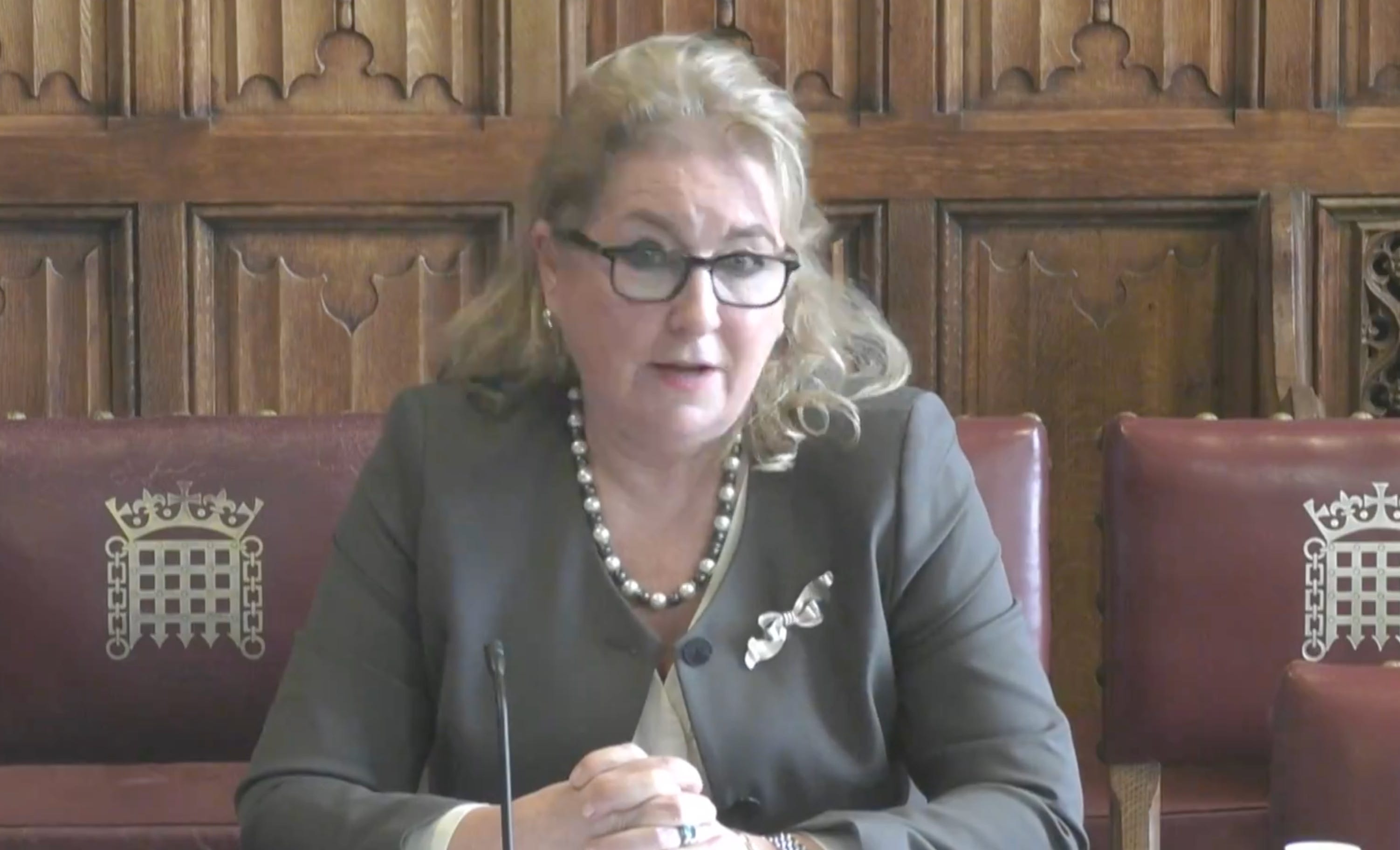
"As you say,” Carr told the former first minister of Wales Lord Jones of Penybont, “it’s very important to understand the context in which judges operate.”
She continued:
It’s also very important to understand that the law, even in the context of sentencing, can be extremely complicated, particularly, for example, when you’re dealing with young people or vulnerable people…
However concerned and disturbed anybody is — with good or bad reason, justified or not — nothing justifies the sort of abuse of individual judges, let alone death threats and more that individual judges are presently subject to.
Carr gave no further details. But her reference to young or vulnerable people suggests she may have been thinking of the two teenage boys convicted of raping two young girls at Fordingbridge, Hampshire, who were given non-custodial sentences by Judge Nicholas Rowland at Southampton Crown Court on 21 May. Rowland was widely criticised by politicians and others until a transcript of his sentencing remarks was made available a week ago.
Judicial security remained an absolute priority, Carr told Lord Cryer. It was not just about protecting individual judges, it was about protecting the rule of law. As she explained:
It was central to diversity: underrepresented groups were more exposed to abuse and online attacks. As a result, some people were deterred from applying for high-profile judicial positions.
It was foundational to transparency: judges whose sentencing remarks were filmed for broadcast were more likely to be recognised.
It was also linked to complaints about judicial misconduct: the more information that was published about disciplinary matters, the more exposed a judge might be to the sort of attacks that the head of the judiciary and her colleagues were trying to protect them from.
Parliament
The lady chief justice is also keen to maintain “comity” between the judiciary and parliament. She gave written evidence in March to the Commons procedure committee, which had been asked by the Commons speaker last year to examine the sub judice resolution under which MPs agree to restrict what they say about current court cases.
Carr told peers yesterday:
We know that the sub judice rule is a critical safeguard both to judicial independence and parliamentary privilege. We, the independent judiciary, play our part by not commenting on policy matters, by developing the common law and applying it in a way that is respectful of the separation of powers.
And, as I said in my evidence to the procedure committee, it is a two-way street. Parliament in turn needs to respect the work of the judges and the courts and to respect that fundamental principle of comity.
I understand all too well that respect begins with understanding, and here some of the work that we can do together comes into play.
The lady chief justice explained that she was taking steps to help MPs and peers understand better how the judiciary works
“I think in the context of some recent legislation there was an amendment tabled in relation to judicial training,” she said — again without mentioning any names, but perhaps referring to an attempt by the Liberal Democrat MP Jess Brown-Fuller to ensure that judges were given what she saw as appropriate training on matters relating to violence against women and girls.
“That demonstrated to me that there was an absolute lack of familiarity with section 7 of the Constitutional Reform Act, under which judicial training is exclusively a matter for me,” Carr said firmly.
She has appointed parliamentary liaison judges — originally two and now four — who engage informally with parliamentarians and then report back to the senior judiciary. They have not been publicly named.
Judicial appointments
Nor have the new master of the rolls and the new president of the King’s Bench division. But they have been chosen — Carr was on the appointments panel — and she expected their names to be announced long before they take office in October.
They had been selected even though there has been a vacancy at the top of the Judicial Appointments Commission since the beginning of this year. Professor Lynne Berry CBE is the government’s preferred candidate for the post and, by coincidence, she was appearing before the Commons justice committee for pre-appointment scrutiny as Carr was giving evidence to the constitution committee.
Berry will be interested in Carr’s remarks, just as Carr will be interested in reading the transcript of Berry’s evidence. A series of questions from Dr Neil Shastri-Hurst has already attracted some attention.
The Conservative MP reminded Berry that the government had been seeking to appoint a chair of the Judicial Appointments Commission with “substantial knowledge or understanding of making senior appointments on merit”. That was something Berry was very used to doing, she told him.
This was how their subsequent exchanges were recorded:
Dr Shastri-Hurst: The job description specifically sets out merit and I think the public would want to know that it is the best candidates who are being selected for this important role. Do you agree that merit alone should be the sole consideration?
Ms Berry: I do not believe that merit alone is the only consideration that the law allows. Merit is crucial, but so is a focus on diversity and on good character. There are a number of things there but without merit you do not go further. Merit is crucial.
Dr Shastri-Hurst: Where do you see the balance between those competing factors? Most people, if they are before a judge, would want to know that the person making that decision is the most qualified to do so, irrespective of colour, religion, caste or race. How do you do that balancing exercise to ensure that you are getting the best person for the job?
Ms Berry: You start off by being really clear about what constitutes merit. I have found it really interesting that there are quite a few different views of what merit looks like. For me, it means integrity, independence, good judgement and sound and excellent intellectual capacity. It also means practical things such as being able to run a court well. These are increasing issues, particularly with the perception — and the reality — that cases are taking far too long. Those are the basics; any person getting through needs to be able to demonstrate those.
Quite possibly, they need to be able to demonstrate other things too. In the very complex cases that go to certain levels of judge, there is a whole range of issues about balancing different rights and making sure that decisions are made well.
Judges need to be good communicators. I really think that that is quite important. It is not something that you do out of the public eye; it is something that you do in the public eye. Words have significance, meaning and consequences. I would want to make sure that the judges were also good communicators.
If, in addition, issues about good character and diversity are coming into it, that is really important, but the first step is merit.
Carr, too, spoke about diversity in the context of recruiting new magistrates. She said the current recruitment campaign was “targeting individuals aged between 35 to 49 to bring down the age profile, and also targeting people from lower income and diverse backgrounds to build a magistracy that is more diverse”.
The justice committee had expressed concerns about the challenges of recruiting magistrates in a report published yesterday morning.
Update 12 June: the committee has endorsed Berry’s appointment. The committee was told there was only one other appointable candidate.
It goes without saying that death threats to Judges is totally unacceptable but the fact that they are happening at all shows the shocking state of our whole society as it currently stands with our country’s borrowing costs for our State to operate at all is the second worst after Botswana in the whole world. Financial failure of this magnitude usually leads to a State of Emergency. If these threats came after the non custodial sentence of two teenage boys found guilty of an appalling rape of a young teenage girl who felt a rock had been smashed into her face after having to relive her trauma to stand up and testify should at the very least have been explained completely fully by the judge at the time. I am well aware from hearing from a Crime & Police Commissioner of an appalling teenage crime causing millions of pounds damage to the charity vehicles of one of our major cities explaining his dilemma in being loathe to give these 2 teenage boys custodial sentences because of the fear of them being made more dangerous in the institutions meant to both punish and reform them because of the drug problems within them. But neither is it right to not give a punishment to two teenagers mercilessly raping a young girl traumatised for life so that at least she feels the justice system has delivered the punishment they actually deserve.
I think too much emphasis is being given to diversity.
For my part we should be talking about competence and good judgment. Too many of our leaders lack those qualities. Politicians should do their part in defending judges and not be scoring political points, often commenting when not in full possession of the facts.