
Radical and revolutionary
Former judge eviscerates Lammy’s planned jury reforms

The Commons justice committee has published a powerful 35-page defence of trial by jury after asking a former criminal judge how he thought the government’s planned criminal court reforms would affect the judiciary. Geoffrey Rivlin KC, formerly the senior judge at Southwark Crown Court, called on ministers to think again.
In written evidence to the committee released this week, Rivlin wrote:
The latest Ministry of Justice proposal presages one of the most radical and revolutionary events in English legal history. Yet it has not appeared in any manifesto; it has not been put out for consultation; it has not been recommended by [Sir Brian] Leveson…
I join with the professions in sincerely hoping that the prime minister and lord chancellor will have second thoughts about the government’s judge-alone proposals. When it comes to indictable crime, they should not abandon their long and deeply held principles that the right to trial by jury is, and should remain, the cornerstone of our criminal justice system.
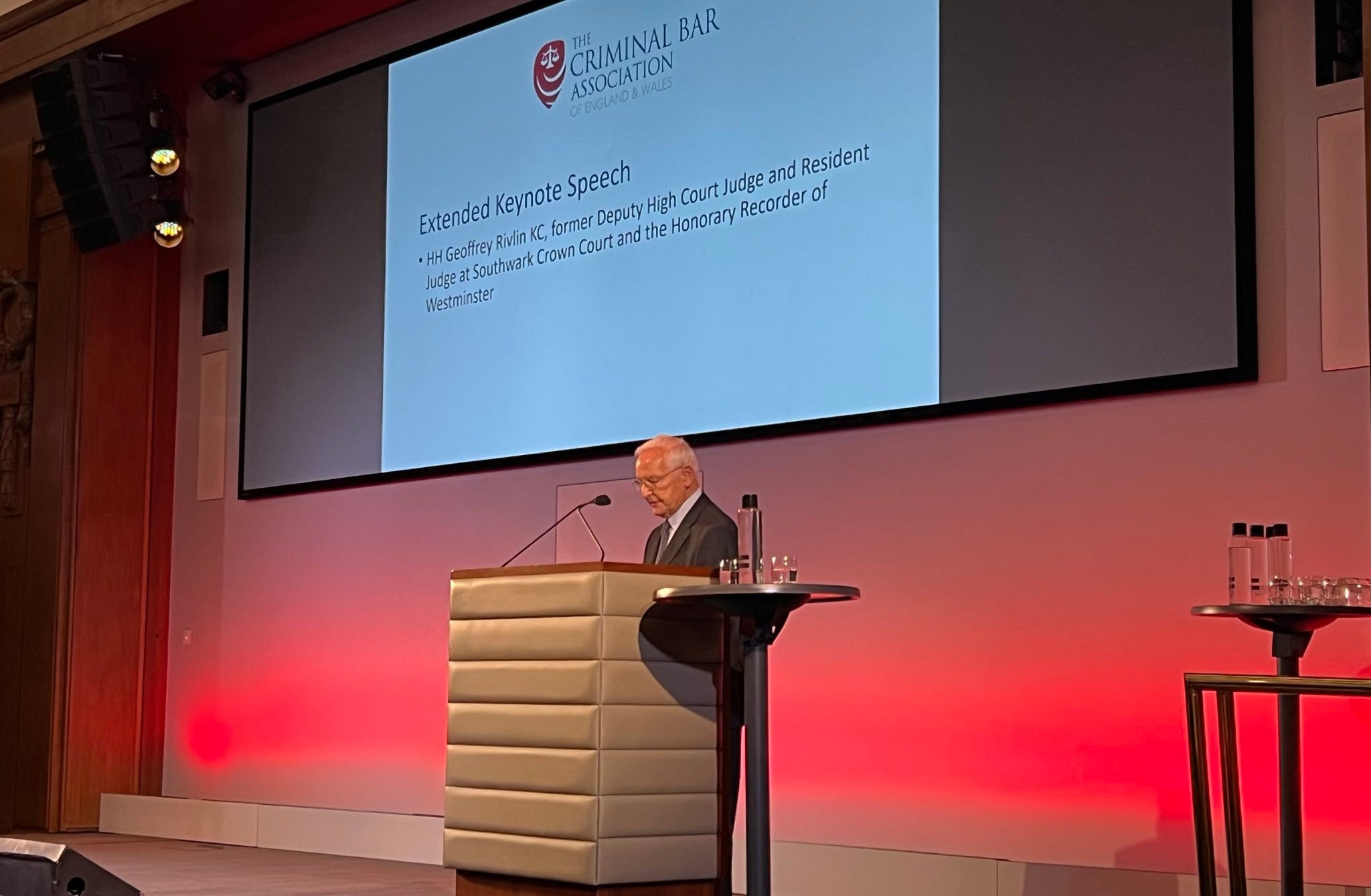
Rivlin’s concerns are well known — though not known well enough, it appeared from a Commons answer by David Lammy last month, to the lord chancellor and justice secretary himself. The former judge said he feared the backlog of cases awaiting trial in the Crown Court was being used by ministers as a “convenient and expedient excuse to resurrect the old (and failed) ‘judge-alone’ arguments”.
Rivlin told MPs:
Nobody can seriously suggest that the utterly scandalous backlog of around 80,000 cases now awaiting trial, let alone the many other failings within the system, can be attributed (even in part) to the use of juries as “judges of fact” in the more serious criminal cases…
Even if all the Leveson and Ministry of Justice proposals for judge-alone trial were implemented, it would not have the slightest impact on the backlog.
A flawed premise
Rivlin challenged the premise of Leveson’s report to the government last summer, which was “that there exists no such constitutional or common law right to a trial by jury”.
This statement was “seriously flawed”, Rivlin argued:
Our jury system may not be beyond change — over the years it has been adjusted a number of times. Parliament may have the power to abolish it. But the great tradition of trial by jury has an honoured place in the constitution and its place is at the top table.
It gives us far more than protection against state oppression. It provides an irreplaceable leavening of the inflexibility that trials by judge-alone would necessarily involve…
Jurors put an unseen but vital brake on excess of power. When some types of legislation are being considered by government or decisions are taken by prosecutors, one thought in their minds will be: could we ever get this past a jury?
It is a logic of the Ministry of Justice’s latest proposals that if a government wishes to pass a law that whittles down the freedom of its citizens, it merely has to ensure that the statutory maximum sentence for any transgression will be one of three years.
John Lewis service
As well as challenging what little we know so far of the government’s plans, Rivlin picked apart Leveson’s recommendations — particularly one that Rivlin derided as the “John Lewis customer service offer”. Leveson had argued that “allowing a defendant, particularly if they have had professional legal advice, to elect a trial by judge-alone can be seen as an enhancement of the defendant’s effective participation in the criminal process”.
What about the victims, Rivlin asked:
Surely, any defendant who is given the choice will base it on the forum more likely to result in an acquittal? What other consideration would motivate them? Where does this leave the victim, who is given no choice in the matter and would face the trial knowing, or believing or at least perceiving, that the system has already given the defendant an extra unfair advantage — a choice as to how he or she is to be tried.
A victim, particularly in a case of indecency, might well wish to have their evidence evaluated by a jury. Their sole right is to be consulted by the prosecution. Where is equal justice here?
We might also spare a few thoughts for solicitors and counsel, and perhaps even some for the judiciary. Leaving aside the inevitable problems of “judge-shopping” and the proclivities of the judge who you think is going to hear your case — a box even Pandora might forebear to open — we need to consider what would happen under this system.
Solicitors and counsel: How are they to advise when it comes to mode of trial? Each one will have their own views and their own prejudices as to mode of trial. They will have to consider and advise the client of all the pros and cons of the two options (and then, no doubt, when the trial gets under way, be at risk of wondering if it has all gone wildly wrong).
Judges: How are they to decide? The judge must determine the answer on a case-by-case basis, by deciding what is in the best interests of justice. Judges are very different from one another, in personality and experience. How can the judge be confident in knowing what is in the best interests of justice — his or her justice, or jury justice?
Burden on the judges
One of the government’s arguments in support of non-jury criminal trials is that judges already sit alone when trying civil cases. But these trials do not normally have the same type of public involvement, Rivlin observed:
All the Crown Court judges who presently try crime have signed up to trial by jury – leaving all the ultimate decisions of fact to a body of citizens free of the spotlight and free of criticism.
In indictable cases, if we had judge-alone trials, the burden on a single judge both in terms of fact-finding and trial management will be hugely increased…
Judges will be expected to shoulder the enormous responsibility alone. This will put a very considerable extra strain on them. On a purely personal note, which may or may not resonate with serving judges, I remember well how arduous and exhausting the conduct of a long trial could be.
It is hardly unrealistic to speculate that in some judge-alone cases, and not necessarily long ones, the burden on the trial judge could be crushing.
Bias
Rivlin then turned to the problem of perceived bias. Although criminal judges should not enter the arena and take sides, they are required to intervene if the prosecutor has neglected a vital question or failed to produce an essential document. However, he asked, “if they intervene in this way in a judge-alone trial, how could this not be interpreted as bias rather than impartiality — and desiring that the outcome should be a conviction?”
At present, judges may be shown material that is highly prejudicial to a defendant. That would be withheld from the jury. Rivlin asked how a judge sitting alone would deal with this:
Does anyone really subscribe to the conceit that, when deciding grave issues of fact, judges can always, at will, completely disregard whatever they may see or hear and erase it even from their subconscious? Even if some of them do possess this remarkable facility, they can hardly expect that those who appear as lawyers, or the public, or — most importantly — defendants, will believe it too.
Mode of trial
Lammy’s latest proposal, in a letter to the justice committee last month, is that a judge would decide whether a case that does not have to be tried by a jury should be heard by a judge sitting alone. The benchmark for this decision would be the likelihood of a sentence of imprisonment in excess of three years.
Rivlin said that a huge number of serious crimes currently attracting substantial sentences would be caught in this net:
Parliament is not here drawing the line by re-classifying offences. Instead, judges will be given the enormous, time-consuming, unacceptable and disproportionate responsibility for deciding whether a defendant should be tried by judge or jury. Any experienced criminal judge will know how foolhardy it can be to assess sentence before the outcome of a trial…
The lord chancellor wishes to save time and expense but, without more carefully expressed detail, these matters are very likely to give rise to a whole pre-trial industry of representations and hearings as to the appropriate mode of trial.
Recommendations
Asked by the justice committee to maker recommendations, Rivlin said the government should concentrate on the many thousands of cases awaiting trial that could now be disposed of with a non-custodial sentence. Taking these cases out of the system might not be popular, he accepted, but it was the “necessary remedy for a scandal that has arisen from years of inexcusable neglect”.
If we are to at least keep the Magna Carta right to ‘judgement by peers’ we’ll need a lot more of them. Magistrate recruitment requires heavy commitment and is a tight process - only 894 got through the net last year out of 4112.
More are needed as it is.
A different net is needed. We need an ‘only for trials’ panel of magistrates. Jury criteria, trial training only, more flexible sitting arrangements, and a wider cross section. Fully trained presiding justice of course. And keep the right to appeal.
As a civil litigation practitioner for 36 years (until 2019), I regard as utterly facile the government/Ministry of Justice’s argument, in favour of judge only criminal trials, that (most) civil trials are judge only. It is a typical MoJ argument, based not on ‘justice’ but ‘efficiency’, such as resulted in the removal of the virtually unfettered right of appeal in civil cases.
Trial by a judge alone in civil trials is in many respects highly unsatisfactory, but, when it goes wrong or not well, it is someone’s money that is at stake, not their liberty - or where prison doesn’t loom, their unblemished reputation and job prospects.
The prospect of a civil case ending up before a single judge at trial, with little chance of an appeal being allowed, was a major reason why I and other practitioners would advise settlement. It was usually a lottery as to which judge would hear the case and how the judge allotted then tried it. Judges differed in approach, with some better at the job than others. The phrase ‘The Good, the Bad and the Ugly’ was often used by solicitors to explain the situation to clients. At one time in the Chancery Division, barristers would say, if they had a poor case, that at least there was the chance of a notoriously ‘rogue’ judge (now deceased) hearing the case.
Judges didn’t have to be bad to be unpredictable.
Whilst it has sometimes been doubted by lawyers, judges are human beings, fallible, with varying abilities and skills, with different outlooks and unconscious biases. Humans are not constant, varying from day to day according to their health, workload and pressures outside their work. At least one study has been done of judges’ decision making at different times of the day, the period before lunch when judges are getting hungry was identified as a bad time, as a convicted defendant, to be sentenced.
The disgraceful mess that the criminal justice system (in its wide meaning, encompassing court, prosecution and rules) made in the wrongful convictions of sub-postmasters shows that all is far from rosy in the present system, but it is hard to lay the blame for that on juries.