
Sir James Munby
Former senior family judge dies at 77

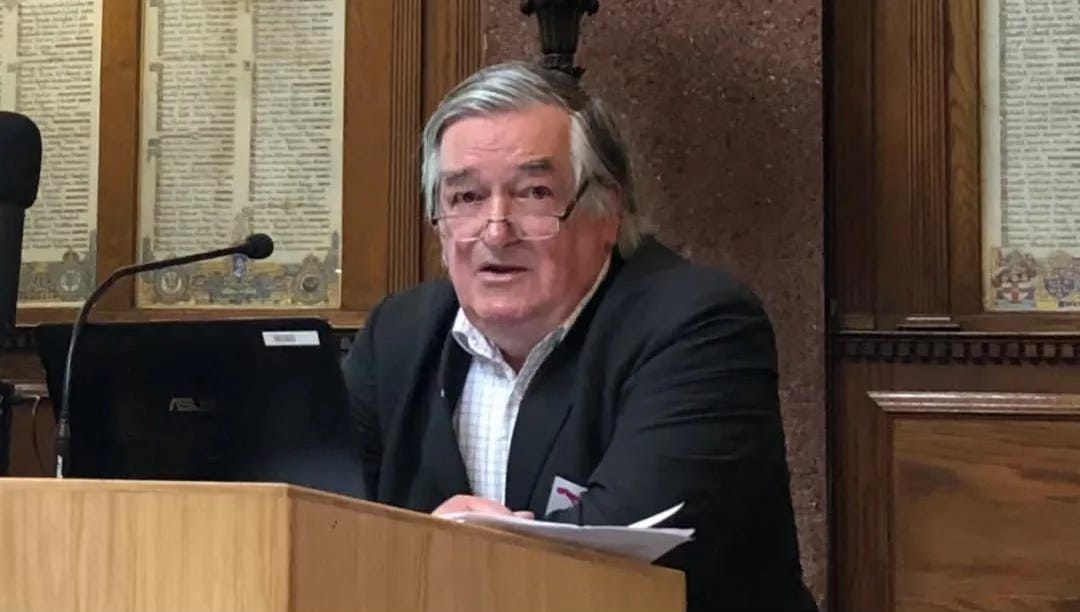
Sir James Munby, former president of the High Court family division, died on New Year’s Day. He was 77.
Munby was a “most highly intelligent and accomplished lawyer,” his successor Sir Andrew McFarlane said. “That he chose to spend the greater part of his career in family law was of great and long-lasting benefit to that important area of jurisdiction. James was a one-off; a very special person, who is now keenly missed by the many of us who knew him well.”
Dickensian
McFarlane added:
Many who knew and worked with James Munby will have valued his friendship and kindness, which was displayed in many ways. An idiosyncratic man, with a Dickensian hint in his manner, he was unerringly encouraging of those more junior to him.
He was a champion of the legally-aided profession, having served for years on the bar’s fees and legal aid committee. As president, he travelled extensively, attending meetings large or small to encourage the judiciary and profession through a challenging time. He stood up for the family justice system and saw it as his duty to speak truth to power where that was necessary.
Wadham
I first encountered Munby as a law student — though he was a year ahead of me and someone I could admire only from afar. The closest thing to a WhatsApp group we had in the late 1960s was the law library suggestions book, a flimsy volume that I found safely preserved in the Wadham College archives when I asked to see it in 2018.1
Most of the requests we undergraduates had made for new books or improved facilities were not intended to be taken seriously. When we poked fun at each other’s suggestions, the conceit was that we would refer to one another by surname, adding the judicial post-nominals we imagined some would hold when we returned for a college gaudy 40 years on. Munby, clearly destined for the senior judiciary, was always referred to as “Munby MR”.
For a while, it looked as if he would indeed become master of the rolls. Though called to the bar in 1971 by Middle Temple, he practised from New Square Chambers, a chancery and commercial set in Lincoln’s Inn. But, as McFarlane explained, “through various sidewinds his practice extended over time into the family division, particularly where some novel point of law was in focus”. Leading barristers still remember his “elegant and compelling advocacy”.
High Court
So when Munby’s appointment to the High Court came in 2000, it was to the family division that he was assigned. Among reporters, he was known for delivering judgments whose eloquence and erudition was matched only by their length. But such criticism was unfair, his former colleague Sir Nicholas Mostyn wrote2:
Unlike so many, he had the knack of making a judgment, even a long judgment, highly interesting and challenging — in short, readable. Further, the reader collects from his judgments a strong sympathy for the interests of the weak, powerless, and dispossessed — whether they were failed asylum seekers awaiting deportation, coerced wives or seriously unwell adults and children. A recurring theme is the defence of the weak against a monolithic, unthinking state.
“The posthumous reputation of prominent judges derives largely from the quality of their judgments,” Mostyn added. “In the course of 18 years as a full-time judge, Munby delivered over 600 reported judgments, which must be a record.”
McFarlane, who retires at Easter as president of the family division, acknowledged his predecessor’s achievements:
As a judge, he methodically, both at first instance and at appellate level, sought to codify the often encrusted and at times conflicting case law across the family jurisdiction. The fruit of his diligence and thoroughness in this regard is a true legacy, as his judgments remain authoritative statements and are deployed on a daily basis.
In Mostyn’s opinion, it was no exaggeration to describe him as the Stephen or Blackstone or Coke or Hale of our age. “Munby brought to both substantive and procedural family law his enormous legal knowledge not only of the current general law but also of its history,” he wrote. “It is doubtful that any judge in the modern era has had anything like the legal-historical knowledge that he possessed.”
Law reformer and appeal judge
That made him the ideal person to chair the Law Commission when a vacancy arose at the government’s law reform advisers in 2009. Although the post came with promotion to the Court of Appeal, it effectively ruled out an appointment as president of the family division a year later, when Sir Mark Potter retired.
That position went instead to Sir Nicholas Wall. Sadly, Wall had to retire for health reasons after little more than two years,3 leaving an unexpected vacancy for which Munby was the ideal candidate.
President
McFarlane takes up the story:
As president, James Munby was the right man, in the right role, at the right time. Following the Norgrove family justice review, parliament established the Family Court, moulding the judiciary sitting as magistrates, local judges and High Court judges into one court.
Parliament also enacted a statutory requirement that all social services child-care cases should be concluded within 26 weeks. This was a most challenging target as the average length of case at that time was over 60 weeks.
As president, and supported by Sir Ernest Ryder, Sir James Munby masterminded this radical programme of change, took personal charge of the drawing up of the many rules, practice directions and protocols that were required (a task for which this dyed-in-the-wool railway enthusiast was well suited!) and, most importantly, led from the front.
Every family judge in the country had personal training. Sir James addressed each course and, having explained task ahead, he concluded, with a Churchillian ring, “this can be done; this must be done; this will be done”.
And done it was as, within three years, the average length of cases came down to around 28 weeks and the Family Court, which we now take for granted, was established.
Exceptionalism
At a broader level, as Mostyn recalled, Munby had waged a lonely battle against what he saw as family law isolationism, the mentality that says that family law is a foreign country where things are done differently:
In one case he said “the family division is part of the High Court. It is not some legal Alsatia where the common law and equity do not apply.”
He recognised in his retirement that he had largely lost this campaign and that family law exceptionalism was a Hydra incapable of destruction, and that this was particularly so as regards the cult of secrecy which envelops almost all family proceedings.
Munby served as president of the family division from 2013 until 2018, when he reached what was then the mandatory retirement age. But that was not the end of his contribution to family law.
Assisted dying
He turned his formidable mind to the Terminally Ill Adults (End of Life) Bill, introduced by Kim Leadbeater MP in October 2024 and now facing a series of amendments in the House of Lords. “I make clear that I say nothing at all about the essential merits or demerits of what is proposed,” Munby wrote at the time. What concerned him was the proposed involvement of the courts. “It is difficult to over-emphasise the profound impact of this on what has hitherto been seen to be the proper role and function of a judge.”
Writing last February, he said a radical amendment introduced by Leadbeater “still falls lamentably short of providing adequate safeguards”.
Blood on our hands
Munby’s deep concern for the most vulnerable members of society shone through a case he decided in 2017. It concerned a girl of 17, detained in a secure unit by order of a youth court.
While there, the girl — referred to as X — had made determined efforts to kill herself on a number of occasions. Staff said:
The care plan to send her back to any community setting, especially [her home town], “is a suicide mission to a catastrophic level”. Staff do not think it will take more than 24 to 48 hours before they receive a phone call stating that X has made a successful attempt on her life.
At a previous hearing, Munby had spoken of X’s desperate need for appropriate therapy in a clinical setting. He continued:
For all that has actually been achieved in the last few weeks, however, despite unrelenting efforts both by the local authority and by other agencies, I might as well have been talking to myself in the middle of the Sahara…
What this case demonstrates… is the disgraceful and utterly shaming lack of proper provision in this country of the clinical, residential and other support services so desperately needed by the increasing numbers of children and young people afflicted with the same kind of difficulties as X is burdened with.
We are, even in these times of austerity, one of the richest countries in the world. Our children and young people are our future. X is part of our future. It is a disgrace to any country with pretensions to civilisation, compassion and, dare one say it, basic human decency, that a judge in 2017 should be faced with the problems thrown up by this case and should have to express himself in such terms…
If, when in 11 days’ time she is released from [the secure unit], we, the system, society, the state, are unable to provide X with the supportive and safe placement she so desperately needs and if, in consequence, she is enabled to make another attempt on her life, then I can only say, with bleak emphasis: we will have blood on our hands.
Family life
A speech Munby delivered to the Society of Editors in 2013 brought together his commitment to open justice and his sensitivity to the profound responsibility exercised by family judges:
There is a pressing need for more transparency, indeed for much more transparency, in the family justice system… Nowhere is this more necessary than in relation to care and adoption cases. Such cases, by definition, involve interference, intrusion, by the state, by local authorities and by the court, into family life. In this context the arguments in favour of publicity — in favour of openness, public scrutiny and public accountability — are particularly compelling…
I have said this many times in the past but it must never be forgotten that, with the state’s abandonment of the right to impose capital sentences, orders of the kind which family judges are typically invited to make in public law proceedings are amongst the most drastic that any judge in any jurisdiction is ever empowered to make.
When a family judge makes an adoption order in relation to a 20‐year-old mother’s baby, the mother will have to live with the consequences of that decision for what may be upwards of 60 or even 70 years and the baby for what may be upwards of 80 or even 90 years. We must be vigilant to guard against the risks.
Munby died unexpectedly at home on 1 January. The former senior family judge is survived by his wife Jennifer, two children and four grandchildren.
Ahead of a college dinner in honour of Munby and Lord Dyson.
In an obituary to be published in the Financial Remedies Journal
Wall was later diagnosed with an incurable dementia-related disease. Munby wrote a warm tribute to him after Wall took his own life in 2017.
Thank you for this beautiful piece. Do you know what happened to the girl X referred to in the judgment?
Excellent piece - thank you! Munby was also influential in the development of ideas about capacity. He gave a lucid seminal lecture on capacity (DOI: 10.1258/mlj.2012.012013) in May 2012, published in the Medico-legal Journal. This involves discussion on regaining lost capacity, and has proved to be important clinically in capacity reports.